


Seagrave Observatory Night Saturday, May 16, 2026
by Jim Hendrickson
Seagrave Observatory Night
Saturday, May 16, 2026
Weather: Clear, 60° light SW breeze
Participants: Michael Corvese, Jim Hendrickson, Linda Bergemann, John Kocur, Jay Baccala
Attendees: 15
Observed: M3, M51, M104, Porrima, La Superba, NGC 4565, M13, M44, Mizar & Alcor, Polaris, and Arcturus
Photos: https://flic.kr/s/aHBqjCUj1Z
Reports by Jim Hendrickson
I arrived at Seagrave Observatory during twilight, Venus and Jupiter had already dipped behind the trees to the west-northwest, and were out of view even from the Clark telescope.
The weather was clear, with transparency about 4 out of 5, temperatures in the low 60s and a light southwesterly breeze that remained comfortable throughout the night. The peepers were chirping throughout the night, but their activity has diminished as we’re nearing the end of their season.
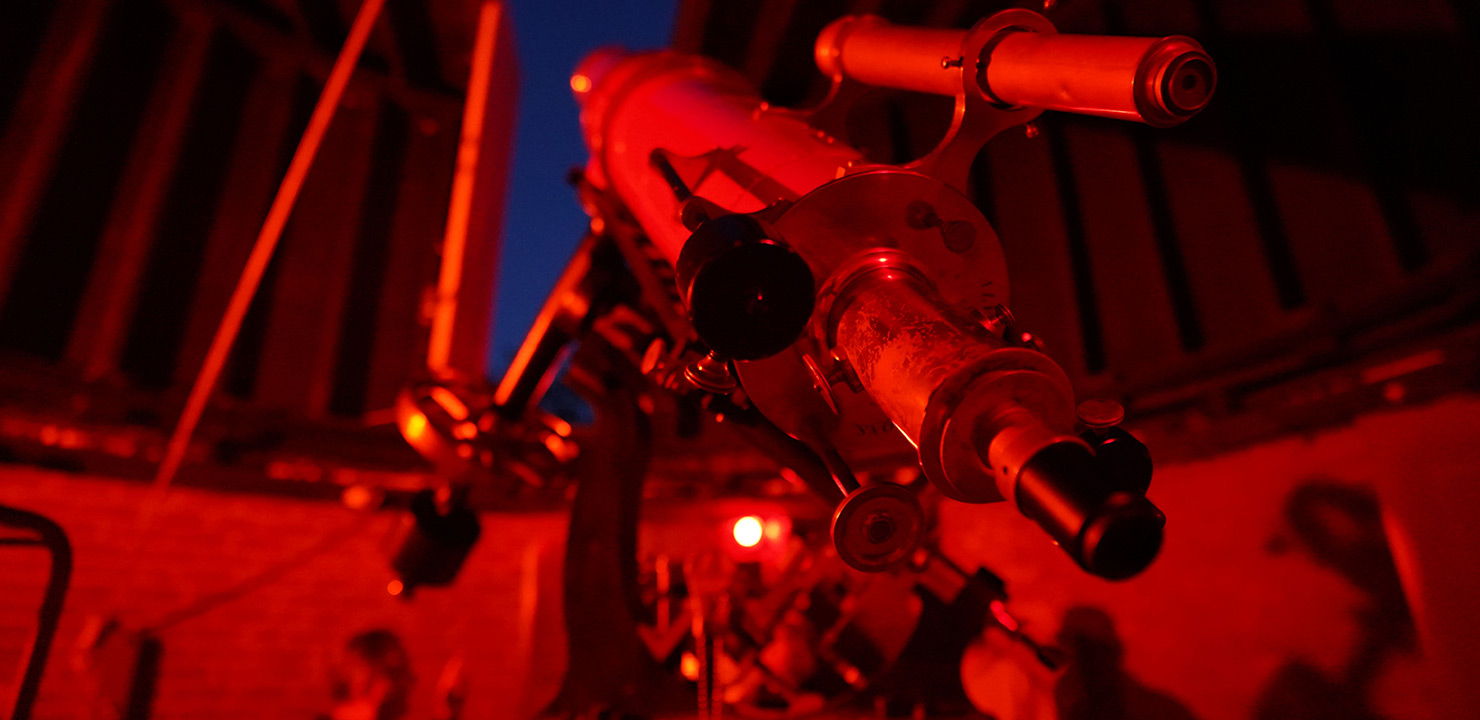
Michael Corvese set up the Clark telescope, ready to aim at M13 once the sky darkened. He entertained several visitors early on, some from as far away as Newport.
In the front yard, John Kocur set up one of the 8-inch Orion Skyquest Dobsonians that was donated to Skyscrapers recently, and observed M44, Mizar and Alcor, Polaris, and Arcturus.
Linda Bergemann served as greeter at the front table. Also present were Jay Baccala, and Bob Napier who arrived later in the evening.
When the sky darkened I aligned the 12-inch Meade on Arcturus, then moved to M3, the globular cluster in Canes Venatici.
A return visitor who had some sky knowledge requested M51, the spiral galaxy in Canes Venatici. Both nuclei appeared clearly, with a general glow around the larger one. Spiral structure was difficult to resolve as the transparency was a little less than perfect. Then, we looked at M104 in Virgo. We seldom get to see this part of the sky from the back scopes, as it is in the appropriate position for just an abbreviated period of time during late April through early May. The dust lane was very apparent, and looking at galaxies brought up discussions about supernovae and black holes.
One couple that had stayed for a while waited until they were the only ones left in the 12-inch observatory to ask if I could find something by coordinates, to which I obliged. They had “purchased” a 10th magnitude star that happened to be located within the Kepler field region of Lyra, a few degrees west of Vega. A pair of stars were located near the center of the field of view, so I couldn’t point out which specific one they were interested in seeing, but they were happy that I was able to find it for them, and that it just may have some exoplanets orbiting it.
A few of our visitors remarked about how many satellites could be seen, sometimes several at once: a substantial increase over just the past few years. Later in the evening, a very bright object, probably close to Jupiter in brightness, rose out of the north-northeast, heading south. Too steep of an inclination to be either the International or Chinese space stations, I checked Heavens Above and found it likely to be Kosmos 1805, a defunct Soviet satellite launched 40 years ago.
There was a pair of passes of the International Space Station, but we missed both of them, as they were low in the north..
Porrima (gamma Virginis) was the next target. A pair of 3.5 magnitude class F0 stars with a 169-year orbit, they were separated by less than one arcsecond at their closest 20 years ago, and are currently about 3.5 arcseconds apart. The stellar twins are separated by an average distance of 43 au, and are located just over 38 light years from us.
La Superba, a notable carbon star in Canes Venatici, was positioned high overhead. It isn’t listed in the LX200 star catalog, so I needed to use the coordinates to locate it. Fairly easy to locate, rather bright, and distinctly deep-orange hued, it is mysterious why this star doesn’t get more attention than it does.
By the time most of the visitors had left, I had time to set up the Seestar. After having some difficulty getting it to calibrate itself in equatorial mode, I removed the wedge and went to alt-az. I had a list of targets I intended to attempt, but at the time a thin wisp of cloud was passing nearly overhead, obstructing some of them. I set the scope to capture the field containing T Coronae Borealis and Caldwell 38 (NGC 4565), an edge-on spiral galaxy 40 million light years away in Coma Berenices.
The session ended at 11:15pm.


