


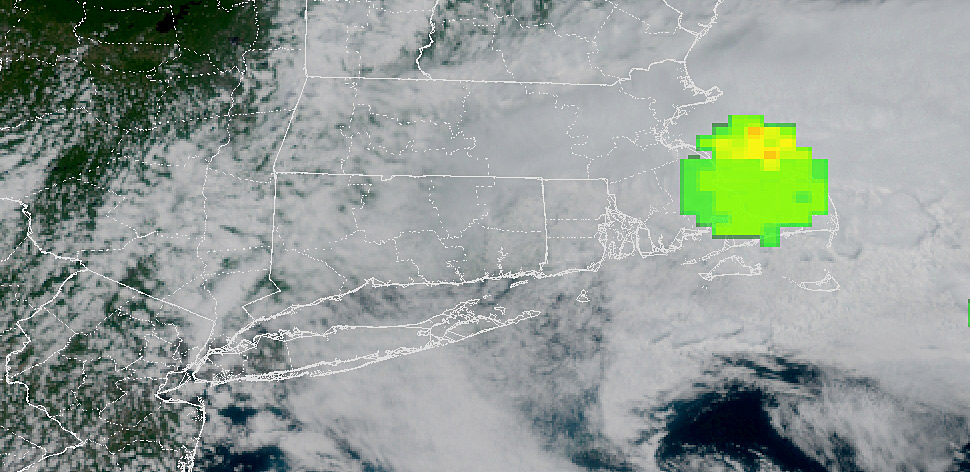
The Great New England Bolide of 2026
July 2026 :
You may have heard, perhaps even felt, or saw social channels light up with questions and speculation, or received a text from a friend asking if you knew anything about that loud boom they had just heard.
Just after 2:00pm EDT on Saturday, May 30, 2026, a day marked by uncharacteristically cold temperatures, wind gusts over 50 mph, and an overcast blanketing the entire region, widespread reports of a loud boom that could be heard as well as felt came from all over Rhode Island, eastern Massachusetts, and parts of eastern Connecticut.
Within an hour, local meteorologists were reporting on a signal detected by the Geostationary Lightning Mapper (GLM) instrument on the GOES-19 (GOES-East) satellite, the geostationary satellite from which many of our national and Atlantic weather maps are derived.
The generated map from GLM appeared to show a strong signal about 25 miles east of Boston and fanning out over a broad area towards the southeast. There were no active weather systems in the area producing lightning at the time, and it was surmised that the signal likely came from a meteor entering the atmosphere.
The meteor was tracked by weather radar stations in eastern Massachusetts, Portland, ME, and Long Island, NY, confirming the non-terrestrial origin of the event.
A statement by NASA Space Alerts confirmed that a nearly 6-ton bolide entered Earth’s atmosphere at 2:06pm EDT on the 30th, traveling at 42,000 miles per hour (18.8 km/s). The approximately 1.5 meter (5 foot) wide space rock exploded as it impacted the denser layers of the atmosphere about 31 miles (50km) in altitude, releasing the energy equivalent of detonating 230 tons of TNT, the shock wave from which causing a sonic boom that most of us heard and felt several minutes later.
The report concluded that meteoritic debris likely fell into Cape Cod Bay.
Unfortunately, with it happening during an overcast day, no one witnessed the flash. If it had occurred at night, even over cloud cover, we most certainly would have seen the flash light up the sky.
In a scenario reminiscent of the 2013 Chelyabinsk event, which was orders of magnitude larger and was captured on many drivers’ dashcams, the boom from the 2026 New England bolide was widely recorded by security and door bell cameras throughout the area.
Late May is one of the quietest times of the year for meteor activity, and the bolide doesn’t appear to be associated with any known meteor streams, which are remnants leftover from comets, or asteroids with comet-like properties. Typical meteors we see at night are about the size of a grain of sand, far smaller than the May 30 event, that simply cause a streak as the particle vaporizes high in the atmosphere, and doesn’t reach the ground. Occasionally we witness fireballs, which are somewhat larger than typical meteors, and generally produce notable trails or flashes rivaling the brightness of Venus, and may even be visible during daytime. Seldom do these produce audible signatures, like last Saturday’s event. A bolide, which is significantly larger, is a small asteroid that results in an explosion when it slams into the atmosphere, often resulting in debris reaching the ground.
Bolides like the one that occurred on May 30 aren’t exceptionally rare, as similar events were reported earlier this year over Texas and Ohio, but it has been several years since one fell over the northeastern US, when one fell in remote eastern Maine in 2023, and of course, the well-known impact in Peekskill, NY, in 1992.
Many sky surveys are focused on locating potentially hazardous asteroids before they approach Earth, including ATLAS, LINEAR, and PanSTARRS, but the object that struck on May 30 was small enough, and fast enough (it traversed the Earth-Moon distance in just six hours), to evade detection.
NASA’s NEO Surveyor space telescope, destined to look for near-Earth objects from the Sun-Earth L1 Lagrange point, is scheduled to launch in September 2027. Although it is designed to look for objects larger than 10 meters in size, it may also be able to detect smaller objects like our May 30 bolide in advance of their arrival.


