

A Century Ago: Goddard's Rocket Reaches for the Stars
March 2026 :
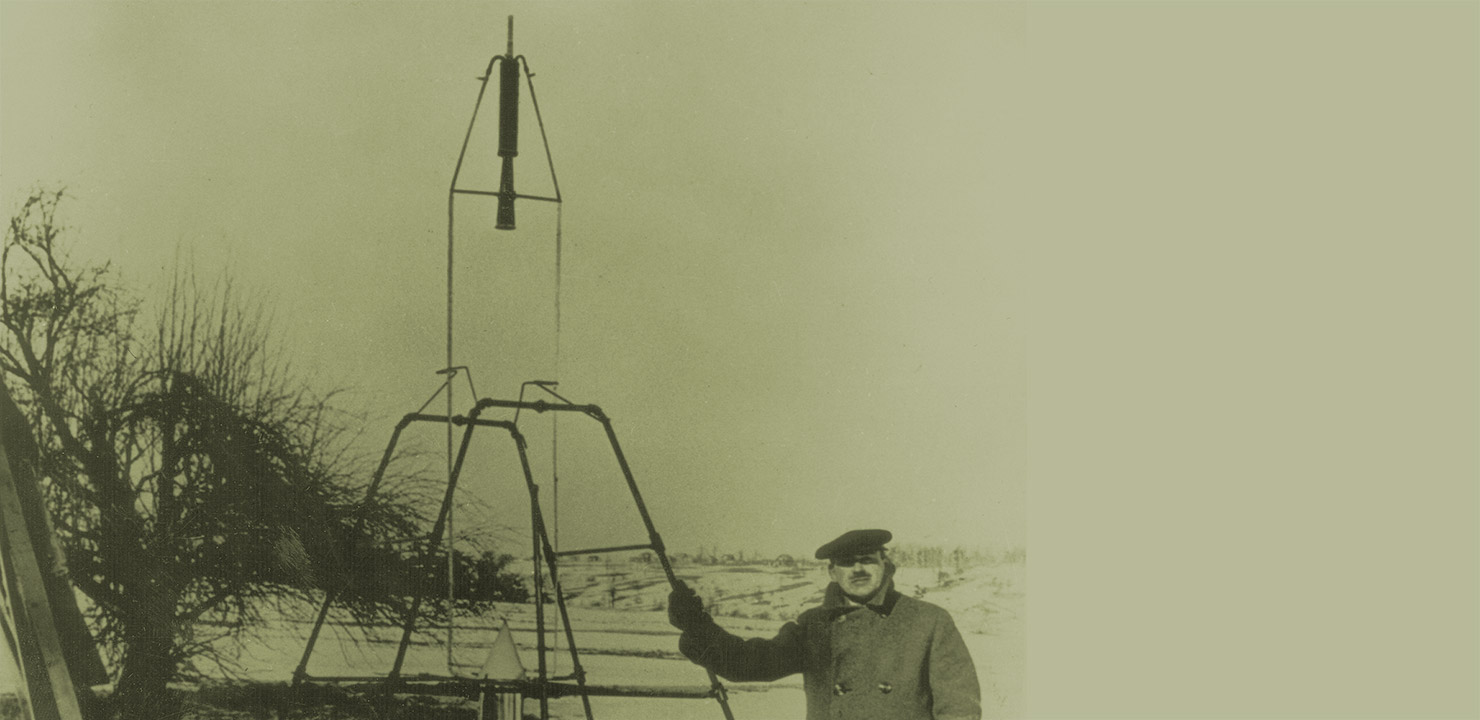
A century ago this March, during a sunny afternoon on a snow-covered farm just 28 miles north of Seagrave Memorial Observatory, an engineer from Worcester, Massachusetts set out to conduct a momentous experiment. A spindly contraption having the appearance of being cobbled together with surplus plumbing and farm equipment, yet being a precision-engineered flying machine, hopped off its launch stand, sped across a field, and would eventually bridge the gap between science fiction and space flight.
Robert Hutchings Goddard certainly didn’t invent the field of rocketry, as we know from a poem written by Francis Scott Key in 1814, a century before Goddard received his first patent. In what would later become America’s national anthem, Key wrote of “the rockets’ red glare,” a reference to the siege weapons used by the British Royal Navy during their overnight attack on Baltimore’s Fort McHenry during the War of 1812. These rockets, constructed of iron casings packed with gunpowder and attached to a long stick, were not much more technologically advanced than those used during the Song dynasty in China over a half millennium earlier.
Robert Goddard was born in Worcester in 1882, and took up an interest in science at an early age. As a teen, his enthusiasm for space flight was sparked after reading H. G. Wells’s War of the Worlds, and in the autumn of 1899, he climbed a cherry tree to prune it, during which he had a vision of creating a machine that could travel to Mars. He would later write that, “I was a different boy when I descended the tree from when I ascended, for existence at last seemed very purposive.” Every year thereafter, he would observe October 19 as “Anniversary Day.”
Goddard earned his bachelor’s degree in physics at Worcester Polytechnic Institute, and pursued his PhD in physics at Clark University, where he would later serve as a research fellow, and eventually chair the department. He filed for, and received, his first patent in the field in July 1914 for a multi-stage solid propellant apparatus. A week later, he was granted another patent (US 1,103,503), the first pertaining to liquid propulsion.
Seeking funding for his research, Goddard submitted to the Smithsonian Institution a detailed report of his work up to 1916, referred to as A Method of Reaching Extreme Altitudes. The work would be published a few years later, and although it was largely a treatise in the theory and engineering of rocket propulsion, one of its concepts contained calculations for sending a one-pound payload of flash powder to the surface of the Moon as a hypothetical experiment to be observed from Earth. As the public was not ready to accept rocketry and space travel as a serious concept, he received much ridicule by the press. Because of this, he preferred to work either privately or with a close cohort of colleagues.
Goddard recognized that hydrogen would be an efficient liquid propellant for rocket engines, but the methods for processing and handling the 14 K (−434 °F) cryogenic fuel would not be achieved for a few more decades, so he chose readily available gasoline to fuel his rocket.
The apparatus appeared simple, but was relatively complex, using advanced methods that are still in use a century later.
The fuel system was pressurized using nitrogen, an inert gas, which delivered fuel from the tank at the aft end (bottom) of the rocket to the combustion chamber at the forward end. Gas pressurization is still used in modern rockets, which typically use helium for its lower mass. The liquid oxygen slowly boiled off and generated its own autogenous pressurization.
The combustion chamber was capped by an injector plate, with holes drilled for the pressurized fuel and oxidizer to flow through, similar to those used in modern rocket engines. The fuel was ignited by a spark plug.
The rocket nozzle, from which exhaust gases are propelled out of the combustion chamber and directed away from the intended direction of travel, was based on the De Laval design, which had been in use in steam turbines.
At a height of 11 feet (3.3 meters) and a diameter of 6” (150 cm), the rocket weighed 11 pounds (4.1 kg).
On the afternoon of March 16, 1926, in a field on his aunt’s farm in Auburn, Massachusetts, Goddard switched on the rocket’s fuel valves and ignitor from behind a blast shield. The rocket fired for several seconds before lifting off its launch stand to a height of 12.5 meters (41 feet), and travelled laterally across the field for a total distance of 56 meters (184 feet) during its 2.5 second flight. The rocket’s total thrust was just 9 lbf (40 N).
As he further refined his rocket designs, newer models would adopt the more familiar configuration of having the combustion chamber and nozzle at the aft end of the rocket.
From the 1930s onward, Goddard conducted his experiments in Roswell, New Mexico, a more suitable location due to its remoteness and more favorable weather conditions. From there, he continued to develop and improve his rocket designs, including gyroscopic stabilization, nozzle cooling, thrust vectoring, and thin-walled fuel tanks, all of which are used on modern rockets.
Unfortunately, his work received less attention within the United States than it did in Germany. Much of America’s effort during the Second World War was conducted by the Jet Propulsion Laboratory at CalTech, while Goddard worked with the Navy to develop fuel pumps for hypergolic propellants for a JATO system for Navy seaplanes. JATO, or jet-assisted take-off, is a system of rocket packs designed to shorten the take-off run of an aircraft, with the terms jet and rocket being used interchangeably. This technology would eventually be transferred to Reaction Motors, Inc., and be installed on the Bell X-1 experimental rocket plane, with which Chuck Yeager flew the first supersonic flight in late 1947.
Only after Goddard’s death during the waning days of the Second World War would his contributions to the field of rocketry gain much wider recognition, and his life and work would come to be celebrated in many ways.
Much of modern life is built upon Goddard’s pioneering legacy, from global communications, weather forecasting, satellite navigation, and of course, pictures from orbiting observatories like the Webb Telescope..
Today, Goddard’s launch site is marked by a granite obelisk adjacent to the ninth fairway on the Pakachoag Golf Course. It was designated a National Historic Landmark in 1966. A full-scale replica of the rocket on its launch stand is on display outside the Charles Hayden Planetarium at the Museum of Science in Boston.
In 1959, the newly formed National Aeronautics and Space Administration announced a new Space Projects Center to be opened in Greenbelt, Maryland to research, develop and test spacecraft for America's space program. The center would open on March 16, 1961, the 35th anniversary of Robert Goddard’s first liquid rocket flight, under the name Goddard Space Flight Center.
On May 19, 1968, his alma mater dedicated the Robert Hutchings Goddard Library in his memory. The dedication was reported by the national press, and was attended by dignitaries such as Edwin “Buzz” Aldrin (just two months before he became the second person to walk on the Moon) and Werner von Braun.
A 93-kilometer crater on the eastern limb of the Moon is named for Goddard. Located at 15.15N, 89.13°E, the crater is best viewed during favorable eastern libration angles during the Moon’s waxing phases only.
9252 Goddard (9058 P-L), a 12-kilometer asteroid that orbits in the main asteroid belt 3.1 au from the Sun is named for the rocket pioneer.
Some notable achievements using liquid-fueled rockets
October 24, 1946
A V-2 rocket, captured by the US Army at the end of World War II, was launched from White Sands, NM, to an altitude of 65 miles, where it took the first photo of Earth from space.
January 2, 1959
The USSR’s Luna 1, launched on a Luna 8K72 3-stage liquid-propellant rocket from Baikonur Cosmodrome, became the first craft to achieve Earth escape velocity. It was designed to impact the Moon, but missed its mark by 6,000 kilometers and went into heliocentric orbit, where it remains today.
November 27, 1963
An Atlas rocket launches the Centaur upper stage from Cape Canaveral, marking the first successful flight of a liquid hydrogen/liquid oxygen (hydrolox) rocket engine, the RL-10, a version of which is still flying and will be used on NASA’s upcoming Artemis II crewed mission to the Moon.
July 14, 1965
NASA’s Mariner 4 probe, lofted by an Atlas Agena D rocket from Cape Canaveral eight months earlier, became the first spacecraft to visit Mars, passing within 9,846 kilometers (6,118 miles) of the planet, and sending back 22 images of its surface.
November 16, 1967
NASA’s Surveyor 6 became the first craft to use rocket propulsion to lift off from another celestial body, the Moon
December 8, 1968
Launched from LC-39A at Kennedy Space Center on Florida’s Cape Canaveral, a three stage liquid propellant Saturn V rocket became the first flight to send humans to a destination beyond Earth, the Moon. To this day (as of February 2026), the Saturn V remains the most powerful all-liquid fueled rocket to lift a payload beyond Earth. NASA’s SLS rocket is more powerful, but uses a combination of solid and liquid propellant, and SpaceX’s Super Heavy/Starship is all liquid, but it has yet to lift a payload into orbit - it is expected to achieve that goal later in 2026.
March 2, 1972
An Atlas-3C rocket lifted off from Cape Canaveral Launch Complex 36 carrying NASA’s Pioneer 10, the first spacecraft to reach solar escape velocity, to date one of only five spacecraft to do so.
No earlier than April 1, 2026
A NASA Space Launch System rocket, using a liquid-fueled core stage, is set to lift off from LC-39B at Kennedy Space Center, carrying four Artemis II mission astronauts on a trip around the far side of the Moon, and to the farthest distance from Earth than any crewed mission to date.
November 19, 2026
Launched nearly a half-century ago on a Titan-3 from Cape Canaveral, NASA’s Voyager 1 interstellar probe will reach the astonishing distance of one light day (25.9 terameters, 173.145 au) from Earth.


