

A Pair of Supernovae in Draco: April 2026
June 2026 :
There are currently two stars that went supernova in the constellation of Draco.
The first was discovered on March 17, 2026 by the automated ATLAS survey in the spiral galaxy NGC 4205. Known as SN2026fvx it peaked at magnitude +12.3 and is currently fading. Reports from late April (22-26) indicate it has faded from its peak, with magnitude estimates of 13.8 to 14.0. Spectroscopy has identified this as a Type Ia supernova. A Type Ia supernova occurs when a white dwarf's gravity steals material away from a nearby stellar companion. When the white dwarf reaches an estimated 1.4 times the current mass of the Sun, it can no longer sustain its own weight and explodes. Type Ia supernova produce a consistent peak luminosity because of the fixed critical mass at which a white dwarf will explode. Their consistent peak luminosity allows these explosions to be used as standard candles to measure the distance to their host galaxies. A distinguishing feature in the spectra of Type Ia supernovae is that they do not show hydrogen lines and have a strong silicon absorption line during maximum luminosity.
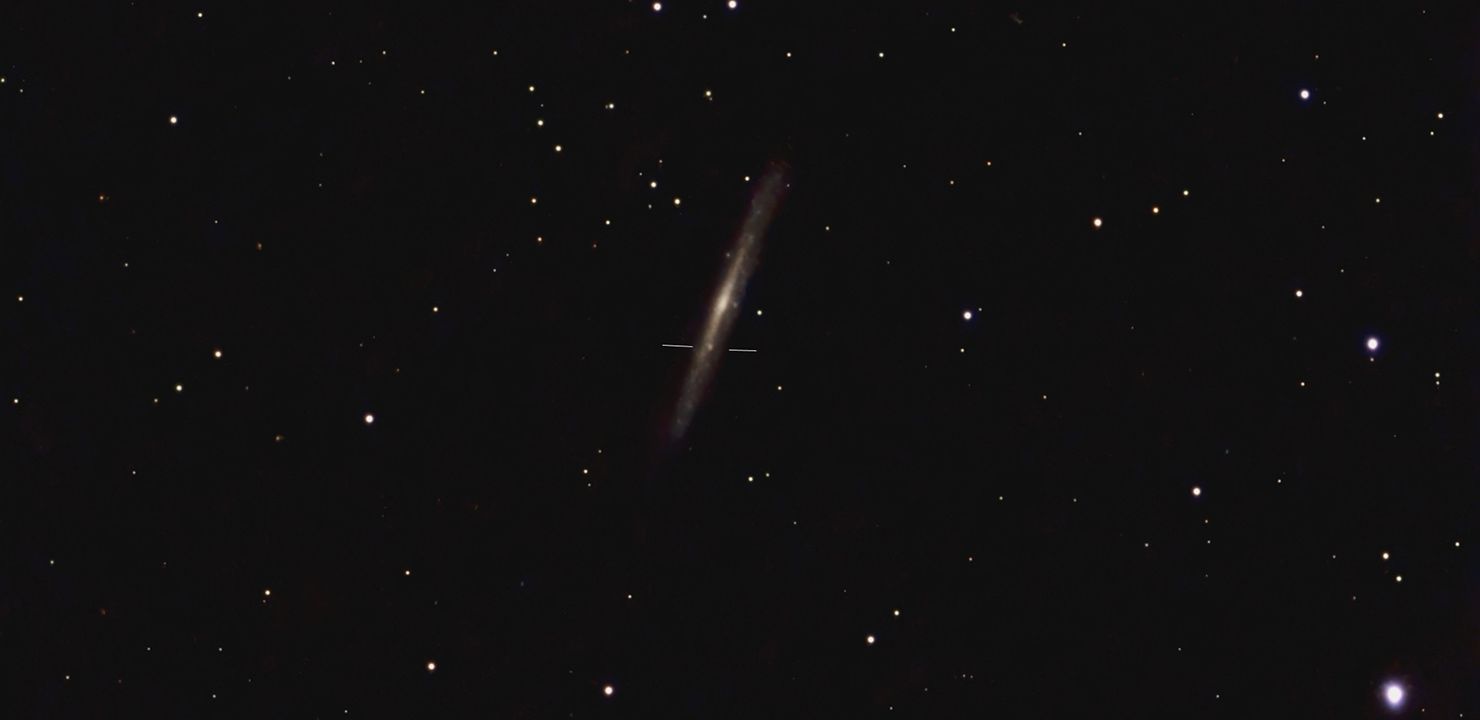
The second supernova was discovered on April 22, 2026, by Japanese astronomer Yasuo Sano in the galaxy NGC 5907. This galaxy is known as the “Splinter” or “Knife’s edge” galaxy since it is seen edge-on. Designated SN2026kid this supernova was magnitude 16.6 at discovery and has since brightened to +15.6 magnitude. Spectroscopic analysis identified this a Type II supernova. Type II supernovae result from the rapid collapse and explosion of a massive star. The star must have at least eight times the mass of the Sun to undergo this type of explosion. Type II supernovae do show hydrogen lines in their spectra.
Upon learning of these two supernovae from reports on the internet, I decided to attempt an image of both supernovae using the Seestar S50 smart scope. The constellation of Draco is circumpolar from mid-Northern latitudes. Being at 27 degrees North latitude, Draco, Ursa Major, Cassiopeia, and Cepheus are NOT circumpolar from my location. Fortunately, Ursa Major and Draco appear high in the sky around midnight during Spring from Sarasota, Florida.
I heard of SN2026fxv first. On April 21, 2026 I aligned my Seestar S50 and attempted to image the supernova. The spiral galaxy NGC 4205 is at magnitude +13.0 to +13.8 and rather unimpressive. However, the supernova was easily visible under Bortle 6 suburban skies and with a 39% waxing Moon! See Figures 1 & 2.
After successfully imagining SN2026fxv I then turned my attention to SN2026kid. In contrast, NGC 5907 is an impressive edge-on spiral at magnitude 11.1. SN2026kid was fainter at approximately magnitude 15.6 yet the Seestar S50 was able to capture the supernova! See Figures 3 & 4. SN2026kid was imaged under Bortle 6 skies with an 81% waxing gibbous moon illuminating the sky!
In conclusion, I will continue to image these two supernovae until they are no longer visible. By the time this article is published, these supernovae would have faded significantly, however, I encourage everyone to attempt to image these rare celestial events. Whether you are using a more conventional astrophotography setup or a smart telescope, imaging a supernova in action is once in a lifetime experience!

References
- Spiral Galaxy NGC 4025 - Wikipedia
- SN2026fvx Supernova in NGC 4205 - Smart Telescopes - Cloudy Nights
- SN2026fvx Latest Supernovae
- Type Ia supernova - Wikipedia
- Spiral Galaxy NGC 5907 - Wikipedia
- SN2026kid Supernova 2026kid in NGC 5907
- Type II supernova Type II supernova - Wikipedia
Related Topics