

A Readily Visible Morning Comet in April
May 2026 :
A brightening new comet designated C/2025 R3 (PanSTARRS) was visible low in the morning sky in the Great Square of Pegasus during the month of April 2026. The name is derived from the PANoramic Survey Telescope and Rapid Response System located at Haleakala Observatory in Hawaii. This facility consists of astronomical cameras, telescopes and computers that continuously survey the sky for moving or variable objects such as asteroids and comets. The comet was discovered on September 8, 2025 having originated from the Oort Cloud with an orbital period of 170,000 years. (See references 1 & 2) Comet C/2025 R3 (PanSTARRS) is expected to reach perihelion on April 19, 2026 at a distance of 0.5 AU from the Sun. The comet's closest approach to Earth will occur on April 27, 2026, with its brightness expected to reach naked eye visibility at magnitude +2 to +3. After April 28th the comet will disappear into the Sun’s glare only to re-emerge in the evening sky in May 2026. Comet C/2005 R3 PanSTARRS will appear in the constellation of Eridanus and rise higher in the sky on each successive evening as it approaches the region below the belt of Orion. The comet will be fading at this point; however, imaging is still recommended to follow the comet through its journey in the solar system. Unfortunately, the comet will continue to remain low in the sky for the Northern Hemisphere.
After having seen various images of the comet taken by amateur astronomers on the Internet and on Facebook, I decided to attempt an observation. I woke up at 5:30am local time and set up my recently acquired Seestar S30 Pro on the driveway of my front yard. The light pollution was horrific with a streetlamp to my right and my neighbors’ lights to my left. (See Photo 1) In addition, there was a wanning 29% phase Moon in nearby Capricornus which did not help the situation. Fortunately, the sky was clear down to the horizon. The comet was conveniently situated within the Great Square of Pegasus. (See Figure 1) The four stars of the square are Alpheratz (α And) at magnitude +2.1, Markab (α Peg) at magnitude +2.5, Scheat (β Peg) magnitude +2.4 and Algenib (γ Peg) at magnitude +2.8. None of these naked eye stars were visible due to light pollution at this low altitude above the horizon from my location!
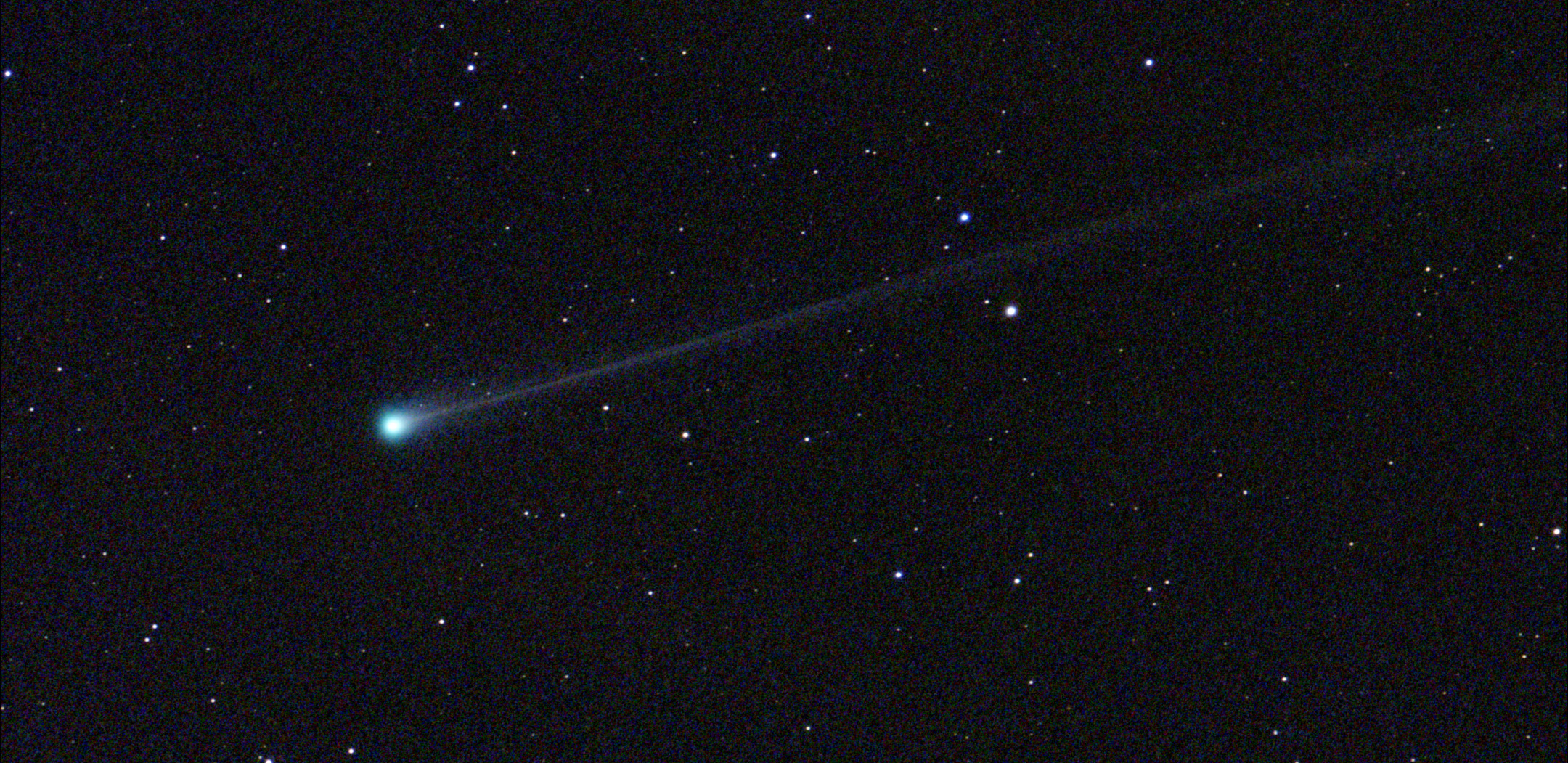
The Seestar S30 Pro has a wide field of view of 2.24 x 3.99 degrees. I had the smart telescope mounted in equatorial mode and began the setup procedure. Each software/firmware update of the Seestar includes a database of the most current comets that are visible in the sky. I tapped on the C/2025 R3 (PanSTARRS) icon, and the telescope slewed to the comet. To my amazement- the nucleus was perfectly centered in the field of view! Given the horrific light pollution, the Seestar S30 Pro easily found the comet, being only 19 degrees above the horizon, on the first attempt. I tweaked the nucleus slightly to the left to allow more of the plasma tail to be seen. (See Images 1, 2 & 3). I took 10 second exposures for a total of 2 to 3 minutes. The comet was at magnitude +4.4 on April 12, 2026 and magnitude +4.9 on April 13, 2026 according to the Comet Observation Database (See references 4 & 5). Note that the nucleus was bright, well condensed with a blueish plasma tail. I was surprised to see so many artificial satellite trails running through the image. The five-minute exposure had eleven visible satellite trails! (See image 1). Notice how many faint background stars were also visible in the field of view. These smart scopes are a “miracle” of technology since they can successfully image faint deep sky images in light polluted skies. Dark sky sites are no longer an absolute necessity for deep sky imaging, only highly recommended. A dust tail was not evident in my image and in other images I have seen on the internet. I attempted to view the comet with 10x50 binoculars once I knew where to look. I could not find the comet with binoculars due to light pollution.

In conclusion, I will continue to image Comet PanSTARRS on every clear morning- weather permitting until it is no longer visible. The comet will be lower in the sky during each successive observation as it continues to brighten. I encourage everyone to get out there and attempt to image/photograph this impressive comet and report all your observations to Carl Hergenrother PhD, Comet Section Coordinator at the Association of Lunar & Planetary Observers at comets@alpo-astronomy.org and carl.hergenrother@alpo-astronomy.org Once the comet re-emerges in the evening sky there will be a renewed interest since this would be a convenient “after dinner” comet. Let’s hope it stays relatively bright with an impressive tail. Time will tell.
References
- C/2025 R3 (PanSTARRS) - Wikipedia
- Will Comet C/2025 R3 (PanSTARRS) be the 'great comet' of 2026? | Space
- Comet C/2025 R3 (PANSTARRS) April 9, 2026 Spaceweather.com Time Machine
- Comet C/2025 R3 (PANSTARRS) COBS - Comet OBServation database
- Comet C/2025 R3 (PANSTARRS): Complete Information & Live Data | TheSkyLive
Related Topics