


Artemis II: We're Going Back to the Moon
February 2026 :
Here in early 2026, few people under the age of 60 have any significant memory of the Apollo Moon landings. Two generations of people have lived during times when no one has ventured to Earth’s nearest celestial neighbor.
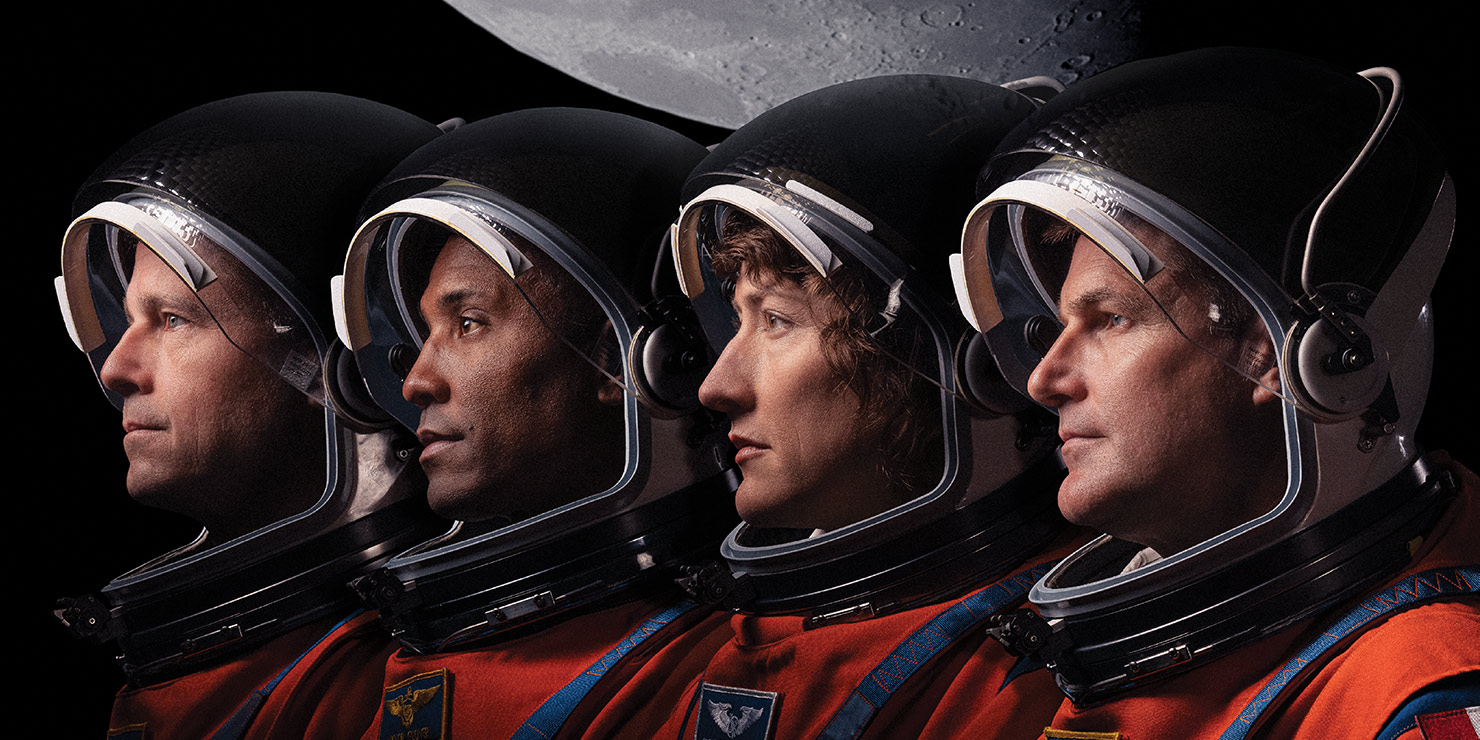
This will change very soon, as NASA and its international partners prepare to send four astronauts on a voyage around the Moon on the Artemis II mission.
Artemis II is scheduled to launch no earlier than February 6, 2026. In addition, there are several opportunities in the following days and weeks if the launch is delayed due to weather or technical issues. After the 6th, there are daily launch windows through February 11, after which the next opportunity, based on the position of the Moon, is from March 6-11, and another from April 1-6.
Apollo: A Look Back
During a four year period from December 1968 to December 1972, nine Apollo mission flights sent 23 astronauts to the Moon, and returned them all safely home (while each Apollo mission had a crew of three, one astronaut, Jim Lovell, was a member of two separate flights). Six of those missions included lunar landings. Of the 23 men who flew to the Moon during the Apollo program of the late 1960s and early 1970s, only five are still with us.
Three additional Apollo lunar landings were planned for, a total of ten, but were cancelled by NASA in 1970, largely due to budgetary constraints.
Some of the surplus Apollo hardware would ultimately be employed for the Skylab program, putting America’s first space station into orbit and sending three three-person crews (none of which were Moon mission flyers), for extended stays lasting up to 59 days. The Apollo-Soyuz Test Project in 1975 was the final operational mission using an Apollo spacecraft.
Much of the remaining unflown hardware, including two complete Saturn V launch vehicles, presently resides in museums.
The cancellation of Apollo led to the development of the venerable Space Shuttle program, which flew 355 astronauts on 135 missions on five different spacecraft over a 30-year period to achieve a variety of significant accomplishments, including living and working in space, scientific research, remote educational programs, delivery and retrieving of payloads, launching interplanetary space probes, on-orbit repair and serving, and of course, supporting the construction and operation of the International Space Station. But the Space Shuttle’s capabilities were limited to low Earth orbit, and could not be used to send astronauts to more distant destinations.
In the decades since the conclusion of the Apollo program, several proposals were put forward to return astronauts to the Moon, but none made it as far as that goal. In 2011, NASA’s Constellation program, which was to develop a pair of new launch vehicles and a new Multi-Purpose Crew Vehicle (MPCV), was cancelled due to budget concerns. Although the project was cancelled, some of its key components continued to be developed under what we now know as the Artemis program, notably, the MPCV (now Orion), and the heavy-lift launch vehicle, now the SLS.
The goals of Artemis have also shifted during the course of its development: from lunar exploration, to direct to Mars, and even a rendezvous with a near-earth object (NEO), before finally being solidified on a return to the Moon. All of the members of this new generation of lunar explorers were born after Apollo 17, the last lunar flight.
The Artemis II Crew
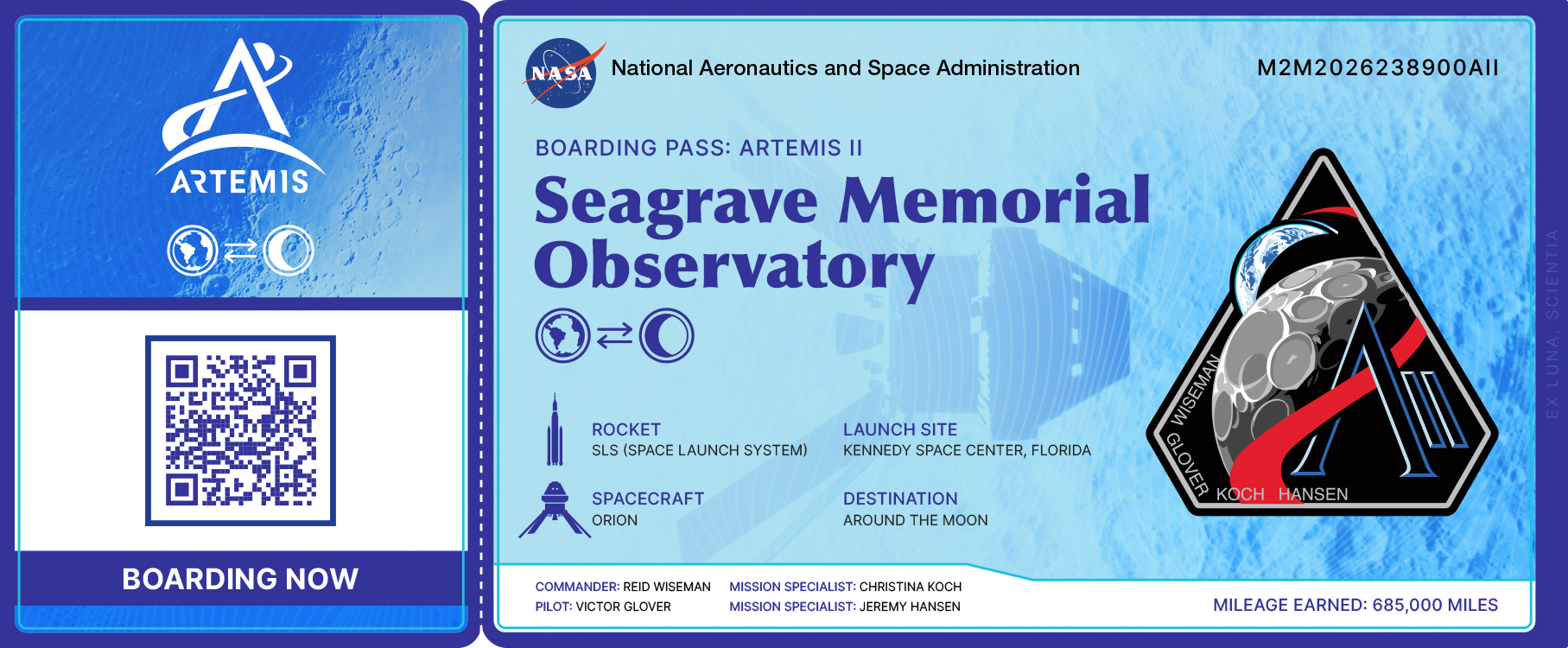
The crew of Artemis II was introduced at a NASA event on April 2, 2023. Compared to Apollo’s three-person crew, Artemis flights will carry four astronauts, the Commander, Pilot, and two Mission Specialists.
Gregory R. (Reid) Wiseman, Commander, is from Baltimore, Maryland, and is 50 years old.
He was selected to NASA’s Group 20 class in 2009 and has been to space once, serving as Flight Engineer during Expedition 40/41 on the International Space Station He departed Baikonur Cosmodrome on board Soyuz TMA-13M on May 28, 2014, and spent a total of 165 days, 8 hours, and 1 minute In space. He conducted two EVAs totaling 12 hours, 47 minutes. Wiseman returned to Earth on November 10, 2014.
Pilot Victor Glover, 49 years old from California, was selected for Group 21, the same astronaut class as Christina Koch. He served as pilot on the Crew-1 mission, the first operational flight of NASA’s Commercial Crew Program, which launched a SpaceX Crew Dragon capsule on a Falcon 9 launch vehicle from Pad 39A at Kennedy Space Center, the same launch pad from which all of the Apollo flights to the Moon were launched. Departing on November 16, 2020, Glover spent 167 days in space, serving as Flight Engineer on Expedition 64/65. He conducted four EVAs totaling 26 hours, 7 minutes, and returned on May 2, 2021.
Christina Koch, Mission Specialist, is 47 years old and from Grand Rapids, Michigan. She was selected to NASA’s Group 21 astronaut class in 2013 and has one prior spaceflight, which launched from Baikonur Cosmodrome on board Soyuz MS-12 on March 4, 2019 to serve as Flight Engineer during Expedition 59/60/61. During her 328 days, 13 hours, and 58 minutes in space, Koch participated in six EVAs, totaling 42 hours and 15 minutes. She returned on board Soyuz MS-13 on February 6, 2020.
Once onboard the International Space Station, Glover joined the crew of Expedition 64/65 as Flight Engineer, and conducted four EVAs totaling 26 hours 7 minutes. He returned to Earth on May 2, 2021, splashing down in the Gulf of Mexico after a duration of 167 days, 6 hours, and 29 minutes in space.
Canadian Space Agency (CSA) astronaut Jeremy Hansen, from London, Ontario, Canada, is 50 years old and a member of NASA’s Astronaut Group 20 class of 2009 as well as CSA’s 2009 Group. He will serve as Mission Specialist for Artemis II, which will be his first space flight.
How to Get to the Moon
The enormous Saturn V rocket was the only launch vehicle capable of sending astronauts to the Moon, but it hasn’t been manufactured since 1968. Its workforce and tooling has long been retired, and most of the systems designed to operate it were dismantled before the Space Shuttle program began operations. As neither the Space Shuttle, nor any of the contemporary launch vehicles were designed for that capability, an entirely new spacecraft and launch vehicle was needed.
Artemis II will make use of the unimaginatively-named Space Launch System (SLS) Block 1 rocket. It consists of an 8.4 meter (27.6 ft) diameter core stage powered by four RS-25 engines that burn liquid hydrogen and liquid oxygen. The engines are leftovers from the Space Shuttle program, with performance improvements to provide a combined 9.1 mN (2.5 million pounds) of thrust. The core stage is augmented by a pair of 5-segment solid rocket boosters, similar to the 4-segment boosters used by the Space Shuttle, each providing 14.6 mN (3.3 million pounds) thrust, for a total thrust at liftoff of 39 mN (8.8 million pounds), which is 17% greater than that of the Saturn V.
The SLS Block 1 rocket is 98m (322 ft) tall, which is slightly less than the height of a Saturn V, and has a total mass at take-off of 2.6 million kg (5.8 million pounds), 18% more than Saturn V.
SLS Block 1 has a smaller upper stage than the Saturn S-IVB, which propelled the Apollo missions to the Moon. It also has a slightly reduced function on Artemis II. The Interim Cryogenic Propulsion Stage (ICPS), so named because it uses cold propellants (liquid hydrogen and liquid oxygen), and that there will be a more capable upper stage coming on SLS Block 1B which will launch Artemis IV, sends Orion into a highly elliptical orbit around Earth, but not quite all the way to the Moon. The remainder of the propulsion for the lunar transfer comes from Orion’s service module.
Sitting atop the rocket is the 10.4 ton Orion crew capsule, which the Artemis II crew has named Integrity. With a diameter of 5m (16.5 ft.) and a height of 3.35m (11 ft), Orion has a habitable volume of 9.34 m3 (330 ft3), which is 64% larger than Apollo. Together with its 15.6 ton European Service Module (ESM), it is designed to carry a crew of four on deep space missions lasting up to 21 days.
In a notable departure from Apollo and Shuttle, which were powered by internal hydrogen fuel cells, Orion is powered completely by solar power and batteries, like the International Space Station. Its four large solar arrays span 19m (62.3 ft), and provide a maximum of 11.2 kW of power.
Artemis II will be the third orbital flight of an Orion spacecraft, and the first with crew on board.
Exploration Flight Test-1, the first Orion flight, launched on December 5, 2014 on a Delta IV Heavy rocket, was designed to test various spacecraft systems, including its re-entry heat shield and parachutes.
The second flight of Orion, Artemis I, was the first test flight of the full SLS launch vehicle, Interim Cryogenic Propulsion Stage, Orion capsule and European Service Module. The mission launched on November 16, 2022 and flew past the Moon, returning some spectacular imagery. Artemis I’s Orion capsule splashed down in the Pacific Ocean after spending 25 days in space.
Countdown to Launch
Artemis II will blast off from Launch Complex 39B at NASA’s Kennedy Space Center in Florida, but it will make the first 7km (4.7 mi) leg of its journey to the Moon on the back of a massive crawler-transporter from the Vehicle Assembly Building. In a scene reminiscent of the Saturn V roll-out, the SLS rocket will already be integrated with its launch tower on what is known as the mobile launcher, unlike the Space Shuttle mobile launch platform configuration, which carried the shuttle stack without its service tower structures, which were located at the pad.
The countdown begins about 48 hours before launch, when engineering teams at three NASA centers convene and begin to power up and test systems on the spacecraft, launch vehicle, and ground support equipment.
A weather briefing is conducted about 10 hours before liftoff, and if reports are green, fueling begins soon after, with over 1,000 tonnes (2.2 million pounds) of cryogenic propellants loaded into the core and upper stages.
NASA will begin live launch broadcasts about four hours before launch, when the crew departs from the Neil A. Armstrong Operations and Checkout Building for the 16 km (10 mile) trip to the launch pad. Once strapped into their seats, the astronauts and teams on the ground continue to configure and test the ship’s systems to make sure everything is ready for flight.
At liftoff, the SLS rocket’s four main engines and two solid rocket boosters produce a combined 39 mN of thrust to send the most powerful rocket currently in service on its journey to the Moon.
As soon as it clears its launch tower, SLS rolls to a precise azimuth to place it into the correct orbit.
The solid boosters burn out and separate just over two minutes after liftoff
Main engine cutoff of the core stage engines occurs 8:06 minutes after liftoff, and the core stage separates 12 seconds later.
The ICPS upper stage and Orion will then coast for 41 minutes until it reaches an altitude of over 2,000 km (1,100 nautical miles), where it conducts a perigee boost maneuver, similar to the way in which the Space Shuttle would conduct its orbital maneuvering system burn after it separated from its external tank, but from a much higher range.
About an hour later, the ICPS RL-10 engine fires a second time for the apogee raise maneuver. This puts Orion into a 380 x 109,500 km (235 x 68,000 mile) orbit, where it will spend an additional 24 hours in orbit, during which it will conduct rendezvous and proximity maneuvers after separating from the ICPS.
In addition to delivering the Orion spacecraft to orbit, Artemis II will deploy four secondary payloads into Earth orbit. The four cubesats were developed by international partners, and carry various experiments and instruments to test technology, communications, and space weather.
If everything goes as planned, on day 2 of the mission, Orion’s service module engine fires for 25 minutes to send the craft and its crew on a trajectory that takes it to a lunar flyby in a maneuver called a trans-lunar injection, something that a crewed mission has not executed since 1972. Trans-lunar injection brings the spacecraft into an area of space where the gravitational influence of the Moon is greater than that of Earth.
The highlight of the mission comes on day 6, when the Artemis II crew will come to within about 7,500 km (4,700 miles) of the lunar surface. We saw the cameras on board Artemis I return some spectacular images of the Earth and Moon together, but this time, Wiseman, Koch, Glover, and Hansen become the first humans in over 53 years to directly see the hidden side of the Moon.
Unlike Apollo 8, which inserted into lunar orbit, Artemis II will perform a lunar flyby and enter what is known as a free return, as the maneuver takes advantage of the Moon’s and Earth’s gravity to return the spacecraft without it having to fire its main propulsion system to significantly alter its trajectory.
The return trip takes another four days, after which the crew will splash down in the Pacific Ocean off the coast of California.
After their return, we will look forward to hearing Wiseman, Glover, Koch, and Hansen share their experiences on this momentous mission, and we will no longer be living in the time when “no one has flown to the Moon during my lifetime.”
The Artemis program continues with an ambitious third flight that NASA says will launch by 2028. This 30-day mission involves a lunar landing of two of the four crew for a week-long stay near the south pole of the Moon. While the astronauts will fly from Earth to the Moon in an Orion capsule, they will use a lander that is being designed and tested by SpaceX to achieve the lunar landing.
The long-term goals of Artemis are not only to establish sustainable human presence on the Moon, but also to work towards the scientific exploration of Mars by inhabitants of Earth.
While these lofty ambitions may still be a long way off, we are hoping that the successful conclusion of Artemis II’s return to the Moon inspires a new generation to explore the universe.
Artemis II Mission Resources
- Artemis II Press Kit
https://www.nasa.gov/artemis-ii-press-kit/ - Space Launch System Reference Guide for Artemis II
https://www.nasa.gov/wp-content/uploads/2025/12/sls-5558-artemis-ii-sls-reference-guide-final-review-print.pdf - Orion Reference Guide
https://www.nasa.gov/wp-content/uploads/2023/02/orion-reference-guide-111022.pdf - Orion's Service Module
https://www.nasa.gov/wp-content/uploads/2018/07/orion_smonline.pdf - Artemis II: Meet the Astronauts Who will Fly Around the Moon
https://youtu.be/lPyl6d2FJGw - Artemis II Mission Availability – Early 2026
https://www.nasa.gov/wp-content/uploads/2026/01/artemis-ii-mission-availability.pdf - Artemis II Posters
https://images.nasa.gov/search?q=Artemis%20II%20posters&page=1&media=image&yearStart=1920&yearEnd=2026 - NASA Live
https://www.nasa.gov/live/


