


Astronomy's Problem with Satellite Megaconstellations
February 2026 :
As astronomy lovers, we often speak on the deteriorating skies brought on by over lighting; but, what about other disturbances that seem to be occurring?
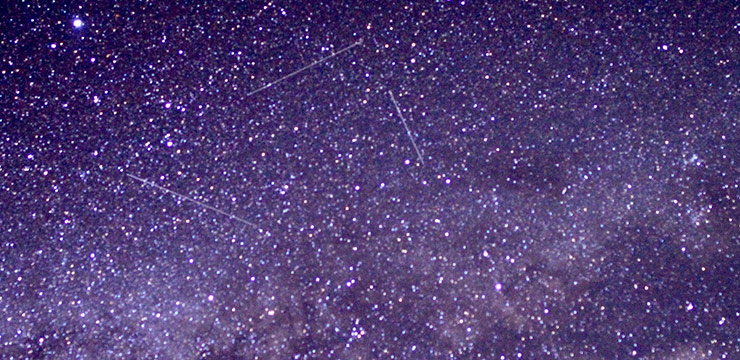
One of the most bothersome problems, as documented in recent issues of both The Reflector and Science, is the number of Starlink satellites that are showing up in many peoples’ astrophotos. The lines created by the satellites passing across the image destroy the beauty of the object being taken. At present, there are over 14,000 satellites in orbit, over two-thirds of them Starlinks, so almost any attempt at a long exposure is bound to have these streaks ruining the picture. At present, the International Telecommunication Union (ITU) is looking into the problem of managing the use of low Earth orbit and what is within it. Although it doesn’t have enforcement powers as such, it is able to keep the information and send it to its 193 member organizations, in hopes they will all assist in keeping the satellite numbers as checked as possible.
In addition, this increase in low-Earth-orbit satellites is having an even greater effect on orbiting astronomical observatories. A study led by NASA focusing on two operating telescopes, Hubble and SPHEREx is estimating that a large number of images by these could be tainted by light emitted or reflected by satellites sharing their low-Earth orbits.
Their research results calculate that as of now about 40% of Hubble’s images, and 96% of those by SPHEREx, could be contaminated by these other satellites’ light. In addition, two upcoming telescopes, The European Space Agency’s ARRAKIHS and the Chinese Xuntian observatories, could suffer the same problem. Hubble’s lower percentage is due to its narrower field of view.
The observatories with much further orbits – James Webb, the ESA’s Euclid, Nancy Grace Roman – will not be affected by this “contamination”; but, with the imaging that takes place here on Earth with those lower orbit facilities, there must be a way to lower the effects on both problems. At this time, the International Astronomical Union (IAU) Centre for the Protection of the Dark and Quiet Sky is looking into thus critical problem, both for those desiring to take beautiful images here, and those who collect the most information from our low-Earth observatories.
Multiple satellite trails visible in this July 25, 2022 image by Steve Hubbard from a dark site in New Hampshire


