

August Meeting
Saturday, August 10, 2019, 7:00 pm
Water on the Moon: How did it get there, what does it mean, and can we use it?
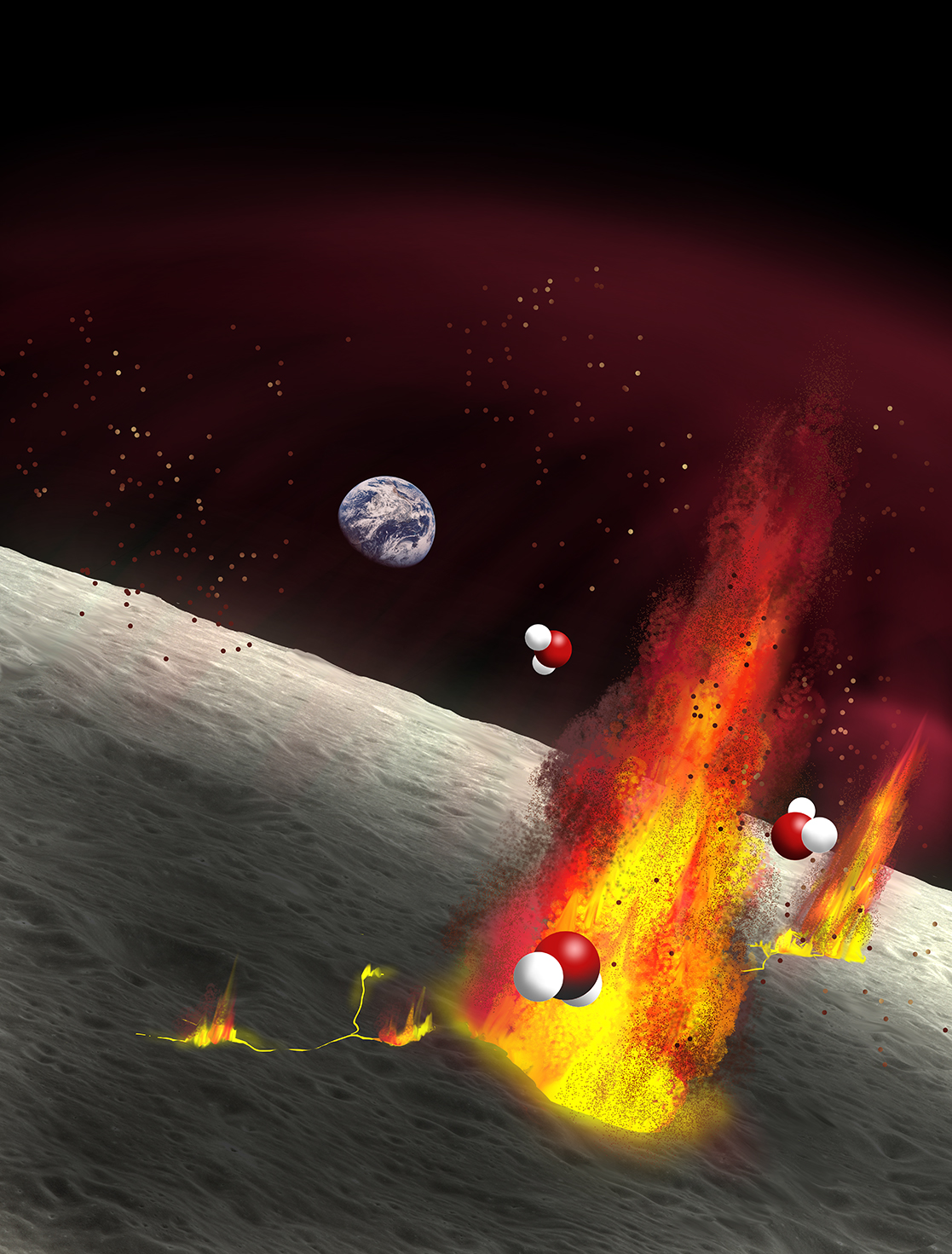
One of the most exciting areas of research in lunar science over the past decade has been the recognition and quantification of water (OH and H2O) in returned lunar samples. Such results can place important constraints on the formation conditions and geologic evolution of the Moon, and water has been measured in a range of lunar materials, including basalt, anorthosite, agglutinate, and volcanic glasses. Though critical for piecing together the history of the Moon, the returned Apollo and Luna samples represent only a small fraction of the lunar surface. In addition, glass beads from the central regions of the numerous dark pyroclastic deposits, formed by volcanic fire fountain eruptions, have not been directly sampled. These larger glass-rich deposits may be more representative of lunar pyroclastic eruption processes on the Moon as a whole. Fortunately, there exist a variety of global datasets acquired by orbiting spacecraft, and remotely sensed compositional information for large scale pyroclastic deposits may provide a link to lab measurements of volcanic glasses in the Apollo collection. It has been previously shown that near-infrared (NIR) reflectance spectra of the lunar surface exhibit absorptions that are diagnostic of OH/H2O. At a global scale, these spectral signatures are largely consistent with formation of OH due to solar wind interactions with the lunar regolith, consistent with direct measurements of water in glasses that are formed during micrometeorite bombardment on the Moon. However, recent analyses of NIR data acquired by the Moon Mineralogy Mapper (M3) instrument have also revealed the presence of water absorptions in nearly all previously mapped pyroclastic deposits. This talk will present estimates of water in different lunar materials that comes from different sources, as well as discuss ongoing efforts to refine such estimates in order to bridge the gap between orbital data and ‘ground truth’ from returned samples. Whether or not these water bearing materials provide a potential resource that can be extracted for human use or the production of fuel for future space exploration will also be discussed.
Ralph Milliken received a B.S. in Geology from Indiana University in 2001, an M.S. in Geology from Brown Univ. in 2003 and his Ph.D. from Brown in 2006. He then spent 4 years at the Jet Propulsion Lab/Caltech as a postdoctoral scholar and then Research Scientist, where he worked on a variety of projects related to the exploration of Mars, including NASA’s Mars Reconnaissance Orbiter. During that time Ralph also became involved in the landing site selection process for the Mars Curiosity rover, and he has been an active member of the rover science team since 2011.He is also the director of the NASA Reflectance Experiment Laboratory at Brown University, which measures the reflectance and thermal emission properties of geologic materials, both from Earth and beyond, in order to help compare lab measurements to those acquired by various spacecraft. Ralph is currently a collaborator on the Japanese Space Agency’s Hayabusa2 asteroid mission, which continues to observe the near-Earth C-type asteroid Ryugu and will return samples to Earth in 2022. Ralph enjoys just about anything related to planetary science, space, and spending time outdoors.