

Book Review: The Martians-The True Story of an Alien Craze that Captured Turn-of-the-Century America
March 2026 :
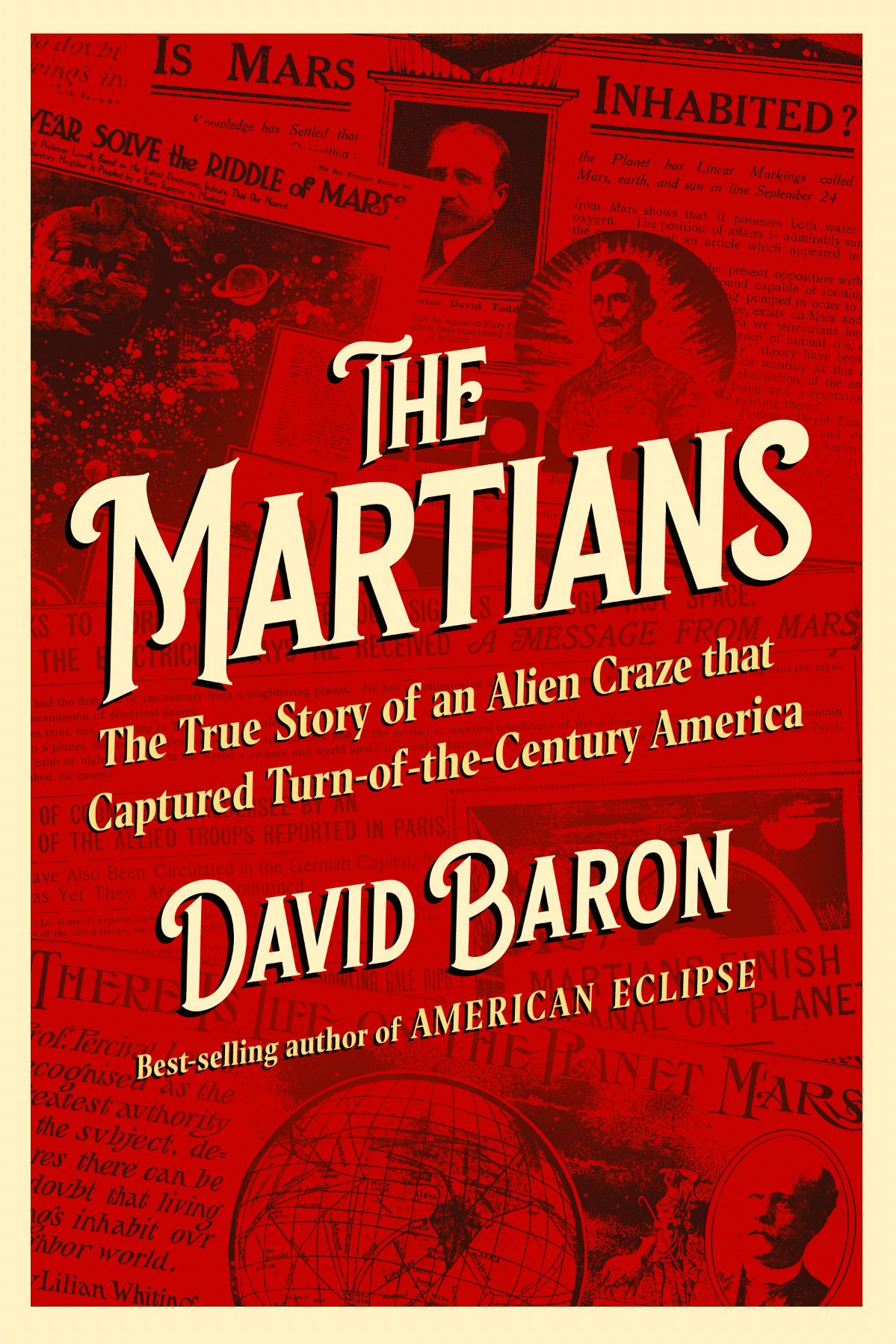
The Martians: The True Story of an Alien Craze that Captured Turn-of-the-Century America
By David Baron, New York: Liveright Publishing Company, 2025, ISBN 978-1-324-09066-3, hardbound, $29.99, US
Reviewed by Francine Jackson
Ron Zincone was right.
If ever a person wanted to learn about the planet Mars and its effect on former financier Percival Lowell, this is the book to choose. The author, in addition to becoming familiar with the life of this infamous character, has delved into his friends and family, and all they did to, in many way, encourage Lowell, or do their best to bring him “back to Earth.”
It was a family catastrophe that brought Lowell to think about more than just living his affluent lifestyle; learning of the alleged “canals” on Mars seemed perfect. He had observed the planet as a kid through his tiny telescope, but the allure of the possibility of life on the planet was too much for him to ignore. He grasped the writings of Schiaparelli, despite so many more who tended to consider this a fabrication.
Assisting Lowell, in addition to several scientists who picked up the sword of life on Mars, science fiction writers came to the fray, pushing the possibility of life on Mars, and keeping it in peoples’ minds.
One scientist who became allied with Lowell was David Peck Todd, who, with his wife Mabel, became proponents of martian life. Todd had been an eclipse follower – although his record for seeing them was abysmal – who, among other attempts to further the cause of life on our neighboring planet, actually dismantled his college telescope and traveled with it to Chile, in order to have as perfect a sky with which to observe and photograph Mars as clearly as possible. Also, in his later years, Todd convinced the U.S. military to have periods of radio silence, in hopes the martians’ communication would be picked up.
Anther early proponent of life was Nikola Tesla, who spend much of his time attempting to send or receive martian signals. Even he, near the end of his life, had second thoughts on the practice.
The lists of both opponents and protagonists of Lowell fill much of 19th century and early 20th century scientists. Those who opposed him did so till the end; those who did rally for him did, like Todd and Tesla, slowly hold themselves back on their support as time went by, especially with such “evidence” of possible illusion, as per Maunder’s experiment with children.
Except for a couple slight errata involving Todd and his wife, this book is an absolute treasure trove of an incredible adventure in a man’s positivity in what in essence wasn’t. It balances the decades of martian observing with concurrent martian travels, courtesy the best science fiction of its times. For anyone searching for the “truth” of next-door alien civilizations, this book is well worth the read.


