


Skylights: March 2026
March 2026 :
Note: This article may contain outdated information
This article was published in the March 2026 issue of The Skyscraper and likely contains some information that was pertinent only for that month. It is being provided here for historical reference only.
The arrival of spring brings some notable changes to our nights. During March, we will see rapidly decreasing darkness, as the hours of daylight exceed night. The bitter cold nights give way to the spring thaw, bringing the earthy scent and the sound of the spring peepers.
The change of season is also indicated in the stars we see in the evening sky. To the west, the Great Square of Pegasus is being consumed by the encroaching evening twilight, and the constellations heralding the arrival of spring are appearing in the east.
The old adage of March coming “in like a lion” is a reference to the celestial feline we know as Leo making its first evening appearance. Concurrent with Leo’s ascension, the Great Bear, Ursa Major, is also rising into view.
The Winter Hexagon asterism, encompassing our familiar winter constellations, is high in the south after twilight early in the month, but notice how quickly it moves west of the meridian each evening.
We have some sights worth watching in our own solar system during the month of March.
The Sun
The annual shift forward to daylight time is at 2:00am on the 8th. We will now be in Eastern Daylight Time, four hours behind Coordinated Universal Time, until November 1.
The Sun moves into Pisces on the 12th, where it will reside for the next 37 days.
The first day of the year with at least 12 hours of daylight is the 17th, with the Sun rising at 6:53am and setting at 6:54pm. Daylight will remain longer than 12 hours until September 25.
Equinox is at 10:46am on the 20th. At this time, the Sun moves into the northern celestial hemisphere (positive declination), where it will remain until September 22nd.
The first sunset in the 7:00pm hour is on the 22nd. Sunsets will continue to be later than 7:00pm through September 12th.
The Moon
The Moon passes 1.9° west of Regulus early in the morning of the 2nd.
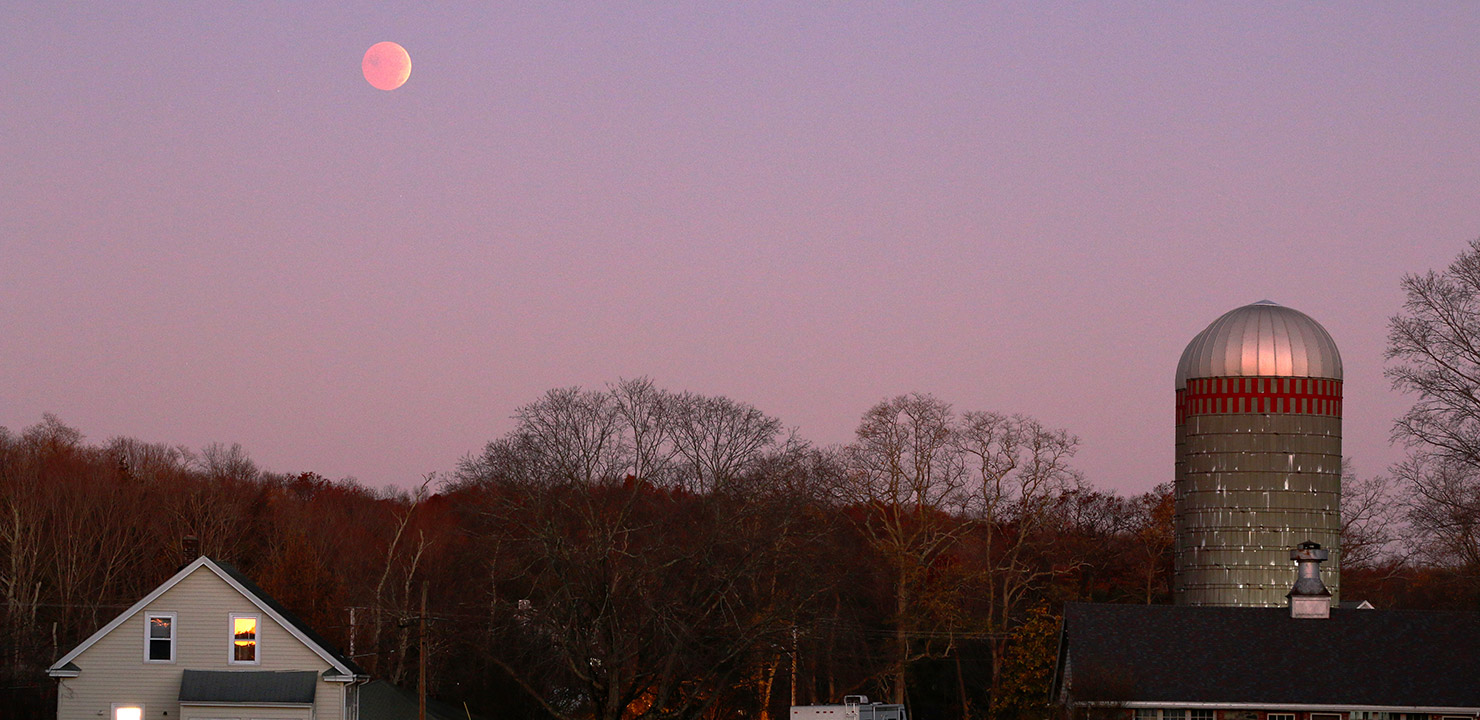
March’s full Moon, on the 2nd-3rd, brings the first of two lunar eclipses visible to us in 2026, and the only one that is total. The Moon rises at 4:56pm on the 2nd, 41 minutes before sunset. The Moon transits at 11:45pm at an elevation of 55.8°.
The eclipse begins when the Moon enters the penumbra (outer shadow) at 3:43am (P1). As this is the outer shadow, it may not be visible until it gets nearer to umbral eclipse start (U1) at 4:49am, which is five minutes into astronomical twilight. Totality (U2) begins at 6:03am, which is eleven minutes into civil twilight, with the Moon just 2.5° above the western horizon. The Moon begins setting at 6:16am, when its lower limb touches the horizon, and it is completely out of view three minutes later. Events we will not see, mid-eclipse is at 6:33am, totality ends (U3) at 7:02am, partial (umbral eclipse) ends at 8:17am, and penumbral ends (P4) at 9:23am.
During the Moon’s waning gibbous phase, it passes 4.1° west of Spica on the morning of the 6th, and 1.5° southwest of Antares on the 10th.
Last quarter Moon is at 5:38am on the 11th, followed by its waning crescent phase.
The 31.3% waning crescent occults magnitude 3.3 τ (tau) Sagittarii, the easternmost star of the teapot asterism, on the 13th. The magnitude 3.3 star goes behind the sunlit limb of the Moon at 4:49am, and reappears from behind the dark limb at 6:20am, in nautical twilight.
New Moon is at 9:23pm on the 18th, marking the start of Lunation 1277. On the following evening, spot the 22-hour old, 1.0% illuminated crescent 6.9° west (about the 4 o’clock position) of Venus in the twilight sky. The Moon sets an hour after sunset.
You’ll have a far easier time seeing the Moon on the following night, the 20th, when the 4.9% crescent sets over two hours past sunset.
On the 22nd, the 20.4% crescent Moon is 3.6° west of the Pleiades cluster.
Just as it’s getting dark on the 24th, the 41.4% crescent Moon is 0.4° south of Elnath (beta Tauri).
The Moon is first quarter at 3:18pm on the 25th, in Auriga.
On the 26th, the gibbous Moon is near Pollux, in Gemini, and a few degrees east of Jupiter.
The 64.9% gibbous Moon occults κ (kappa) Geminorum for 60 minutes beginning at 12:15 am on the 27th. κ Gem is a binary star system 141 light years away. Its primary is a class G8 giant, with a Sun-like companion star 7 arcseconds to the southwest.
A good sight for small telescope observers occurs just after 1:00am on the 28th, when the 75.8% waxing gibbous Moon is within 0.5° of the Beehive Cluster, M44.
The Planets
Mercury
In early March, Mercury rapidly drops out of view in the evening sky after sunset, but this is still a good time to observe it. Through a telescope it shows a dramatic thin crescent over 9 arcseconds across. Observing it on subsequent nights will reveal the illuminated crescent getting noticeably thinner.
Mercury spent February at a higher elevation than Venus in the evening sky, but it trades places with the brilliant planet on the 1st.
The innermost planet is at inferior conjunction on the 7th, but due to its apparent position well north of the ecliptic, it remains above the horizon both after sunset and before sunrise on the 5th and 6th. This is a similar configuration to the last inferior conjunction of Venus in March 2025, but significantly more challenging to observe.
Upon returning to the morning sky, Mercury remains low due to the shallow elongation angle compared to that it experienced in the evening sky for the past few weeks.
The 3.1% waning crescent Moon is 3.5° south of Mercury on the 17th.
During the final days of March, Mercury rises just under an hour before sunrise. Observers with a clear eastern horizon and a larger telescope can see the innermost planet progressing through its waxing crescent phase.
Venus
If you haven’t yet noticed the presence of brilliant Venus in the western sky after sunset, you will very soon. It sets over an hour after sunset. Known as the Evening Star when it is on the eastern side of the Sun, the third brightest object in the sky sets over an hour after sunset in early March, and over 90 minutes later at the end of the month.
Each evening it gets closer to Saturn until the 8th, when it is just 1.0° north of the ringed planet.
Venus is in Pisces, but clips into the northwestern corner of Cetus on the 12th through 13th.
While Venus is very bright, at magnitude -3.9, it is still quite distant, and shows a small, 10-arcsecond, nearly fully-illuminated globe through a telescope.
Beginning on the 25th, and through July 25, Venus sets outside of astronomical twilight, when the Sun is greater than 18° below the horizon and the sky is darkest.
Mars
Mars, although it has crossed into the morning sky, is still too low and close to the Sun to be observed. Due to the position and orientation of the ecliptic angles in the pre-dawn sky, we won’t get a good look at Mars until June.
Observers looking for a challenge may try to spot the Red Planet on the morning of the 16th, when it will be directly below Mercury by 3.5°.
Jupiter
Jupiter is high in the south during the early evenings at the beginning of March, and it is the brightest starlike object in the sky once Venus sets.
The giant planet concludes its retrograde apparent motion on the 11th. It will appear stationary in central Gemini, and slowly resume an eastward apparent motion. Take note of how its position relative to Castor and Pollux changes over the coming weeks.
At mid-month, it appears on the meridian just as twilight fades, and it is notably west of the meridian towards the end of the month.
Saturn
Saturn is getting lower in the west after sunset. The 2nd is the last night it sets after astronomical twilight, but observers with a clear western horizon will be able to observe it for a few more days early in the month.
On the 8th, the ringed planet is 1.0° south of Venus, and on the 10th, it is 2.9° directly below Venus. The separation between the two planets increases by more than 1.0° each evening following, as Saturn gets more difficult to observe, setting before the end of nautical twilight.
Saturn is in conjunction on the 25th, bringing to a conclusion its synodic cycle that was most notable for the recent ring plane crossing. The next ring plane crossing cycle begins in 2038.
Saturn remains out of view for the next few weeks, and will become visible again in May.
Uranus
After Jupiter, Uranus is the only other planet that remains in good viewing position throughout March. The seventh planet shines at magnitude 5.8 and is still easy to locate within the same binocular field of view as the Pleiades cluster, in Taurus.
A pair of 6th magnitude stars 4.0° south of the Pleiades can be used to track the eastward motion of the seventh planet in March.
Uranus encounters the westernmost of the pair, 13 Tauri, on the 17th, when it will be 0.2° south of the star.
On the 23rd, the 44.2% crescent Moon, on its way to pass over the Pleiades, is 4.9° northeast of Uranus. A wide-field telescope or large binoculars should be able to collect all three in the same view.
Uranus is just 5 arcminutes south of 14 Tauri, the westernmost star, on the 26th. The seventh planet continues moving eastward by 2.4 arcminutes per day.
Neptune
Neptune is getting difficult to observe due to its low elevation. On the 1st, it sets outside of astronomical twilight for the last time this season, effectively ending the observing season of our most distant planet.
Observers with a clear horizon and a large telescope may be able to spot Neptune 0.6° east-northeast of Venus on the 6th, and 0.6° southwest of Venus on the 7th.
Neptune is in conjunction on the 20th, and will not be visible until May.
Minor Planets
Pluto remains lost in the glow of twilight. We’ll be able to observe it again in late April.
Dwarf planet Ceres can still be observed in Pisces in March, but it is getting lower in the southwest, and will soon be out of view. Shining at magnitude 9.2 from a distance of over 3.5 au, it is 1.0° south-southeast of magnitude 4.5 ν (nu) Piscium on the 3rd, moving east-northeastward at 0.4° per day. On the 10th, it is 3.7° northwest of Alrescha (α Piscium), and 4.0° north of the star on the 17th.
Makemake is at opposition on April 1, making March and April the best months to observe the distant dwarf planet, although at its great distance of 51.8 au, its brightness doesn’t change much more than a tenth of a magnitude beyond its closest brightness of 17.0. It is located in eastern Coma Berenices, about ⅓ of the way between the Messier globular clusters M53 and M3. Its apparent daily motion is about 1 arcminute per day in a west-northwesterly direction.
Our brightest asteroid, 4 Vesta, is too low in morning twilight to observe in March.
2 Pallas is in conjunction on the 2nd. The solar system’s second-largest asteroid becomes visible in the morning sky in May.
Asteroid 15022 Francinejackson has its first closest approach to Earth since it was named in February 2025. Located in Virgo at a distance of 1.407 au, the 2-4 km asteroid shines at a meager 18.7 magnitude, making it accessible only to deep sky imagers.
On the 28th, Francinejackson is just 0.2° from NGC 4958, a magnitude 10.8 lenticular galaxy.
The Messier Marathon and a Trip Beyond the Milky Way
The stars align (or rather, the galaxies are aligned) during the third week of March, when the night side of Earth is oriented towards our Milky Way’s galactic pole. This gives us the best view of the universe beyond our home galaxy, particularly the Virgo Cluster and other associated galaxy groups covering the nearby constellations of Leo, Coma Berenices, and Ursa Major.
This is also, coincidentally, the best time of the year to attempt to observe all 110 objects from Messier’s Catalog from mid-northern latitudes, and 2026 gives us a New Moon on the 18th, setting up for the darkest possible conditions for the annual Messier Marathon.
An observer attempting to complete the full marathon must find a suitable location away from lights and clear of obstructions on the western, southern, and eastern horizons, and be prepared to remain at the site from sunset until sunrise – an approximate 12-hour duration.
The trick to getting the Messier Marathon off to a good start is to knock off a trio of face-on spiral galaxies that are low in twilight: M74, M77, and M33. If there is anything more difficult than beginning the Messier Marathon, it is ending it, as the final object, the magnitude 7.7x globular cluster M30 in Capricornus, is still very low in the sky through brightening twilight. The later you conduct a Messier Marathon, the easier M30 is to observe, but on the flip side, you also have a greater chance of not seeing the first three galaxies. The ideal dates range from March 20-24th, and if you choose March 20, use the 4.7% crescent Moon to locate M74, which will be 3.8° almost directly above it.
One pair of galaxies that you’ll encounter midway through the Messier Marathon are among the best in the northern sky: M81 and M82 in Ursa Major. Being the two most northern Messier objects, they are circumpolar, and technically visible any time of the night or year, however, late evenings in March are when they reach their upper culmination and are in the best position for observing. And what’s better than putting a single object in your telescope than viewing a pair of them? M81 and M82 make one of the prettiest object pairs visible in a small telescope on a dark night.
Lying just over 20° from the North Celestial Pole and 10° northwest of Dubhe, the outermost star in the bowl of the Big Dipper, M81 and M82 deliver their 12 million year old light together in an eyepiece that affords at least a one-degree field of view. They were discovered by German astronomer Johann Elert Bode on December 31, 1774, more than six years before Messier added them to his catalog, hence they are often referenced as Bode’s Nebaulue (before the nature of galaxies was determined by Hubble in the 1920s, they were referred to as nebulae).
The combined light of M81’s 250 billion suns adds up to visual magnitude 6.9, making it one of the brightest galaxies in the sky. Spanning over 25 arcminutes in the sky, it is about 96,000 light years across, and contains 210 known globular clusters, making it similar to the Milky Way in size and globular cluster population. Its central black hole, at 70,000 solar mass, is 16 times more massive than the Milky Way’s.
Thirty-three years ago, M81 drew the scrutiny of astronomers when the Type IIb supernova SN 1993J peaked at magnitude 10.7 in March of that year.
Viewed in a large telescope or in images, M81 exhibits a nearly perfect, undistorted spiral structure, indicating that it has not had any recent interactions or mergers. Its nearby companion, M82, is quite the contrast.
Classified as irregular, M82 is known as a starburst galaxy, as it has undergone an abnormally high amount of star formation over the past half billion years, likely due to tidal interactions with M81. It contains over 100 clusters of many thousands of hot, massive stars.
Through a telescope it appears similar to an edge-on galaxy, offset about 20° from the perpendicular line towards M81. Its 30 billion suns give it a visual magnitude of 8.4, and is even brighter in the infrared. Two large lobes of hydrogen extend out from the galaxy’s poles, away from its hidden 30 million solar mass black hole.
M82 produced a Type Ia supernova, SN 2014J, which peaked at magnitude 10.5 in January of that year.
Take a cosmic journey to M81 and M82 and enjoy this striking pair of galaxies in the northern circumpolar sky.
Lastly, the recurring nova, T Coronae Borealis, also called the Blaze Star, is visible nearly all night, rising out of the northeast mid-evening early in the month, and just past twilight at the end of March. After an approximately 80-year quiescent period, during which it remains at 10th magnitude, it is expected to briefly spike to 2nd magnitude. The last outburst of T CrB occurred in February 1946, so we’re expecting the next outburst any day now.
A total lunar eclipse occurs at moonset on March 3.


