

Observing the 2025 Series of Titan Shadow Transits
December 2025 :
Saturn’s rings were edge-on in 2025 which afforded the opportunity for shadow transits of various moons. I have imagined shadow transits of Dione, Rhea, Tethys which were difficult to see and rather unimpressive. An online article from Sky & Telescope indicated that a series of 11 shadow transits would occur from April 30, 2025 to Oct 6, 2025. See https://skyandtelescope.org/astronomy-news/observing-news/titan-shadow-transit-season-underway/ These shadow transits were visible only from the Western Hemisphere. This event is unique because another Shadow Transit of Titan would not occur until 2038! Since Titan’s orbital period is 15 days 22 hours a shadow transit occurred on Saturn’s disk every 16 days. I learned in the first week of May about this series of Titan shadow transits. Therefore, I was unaware of the first event on April 30th. Upon further inspection, this transit occurred during the daytime from my location, and the shadow was directly on the ring plane and virtually unobservable. Therefore, I did not really miss this event.
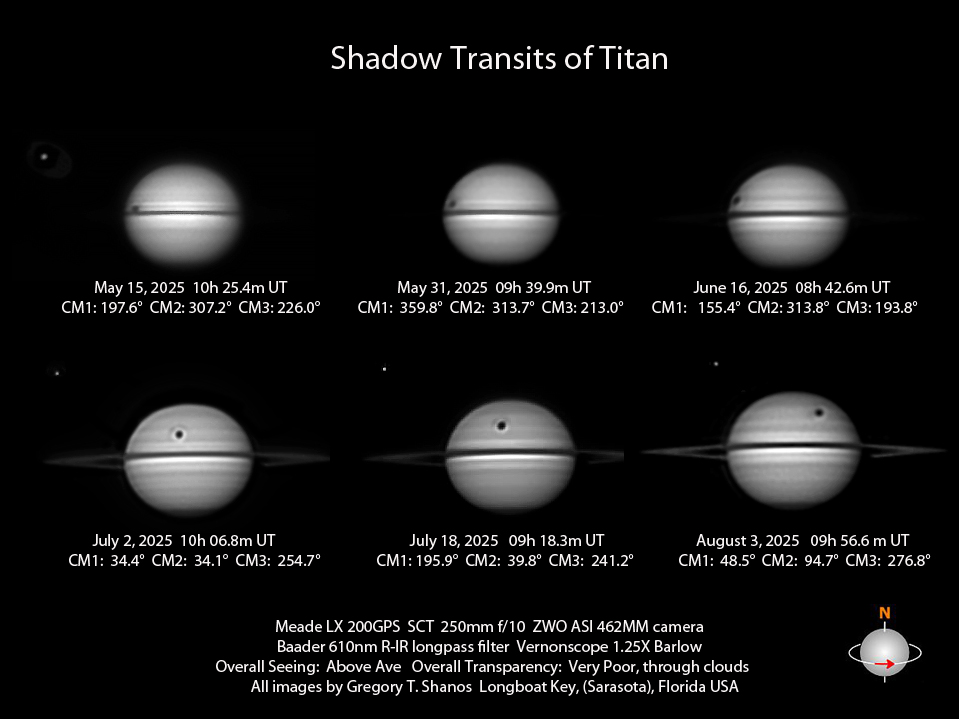
Once I became aware of the ten remaining Transits of Titan, I made it my mission to image all of them. This series of shadow transits will surely be historic since there are 11 in a row each 16 days apart. The odds of that happening are astronomical- pun intended! Figure 1 shows the first set of six shadow transits from May 15th through August 3, 2025, taken under adverse observing conditions. All were taken under cloud cover which thickened and thinned as the night progressed. Most planetary imagers would not have attempted to observe on an evening with such poor transparency. Fortunately, the seeing was above average through the cloud cover which resulted in a higher resolution image.

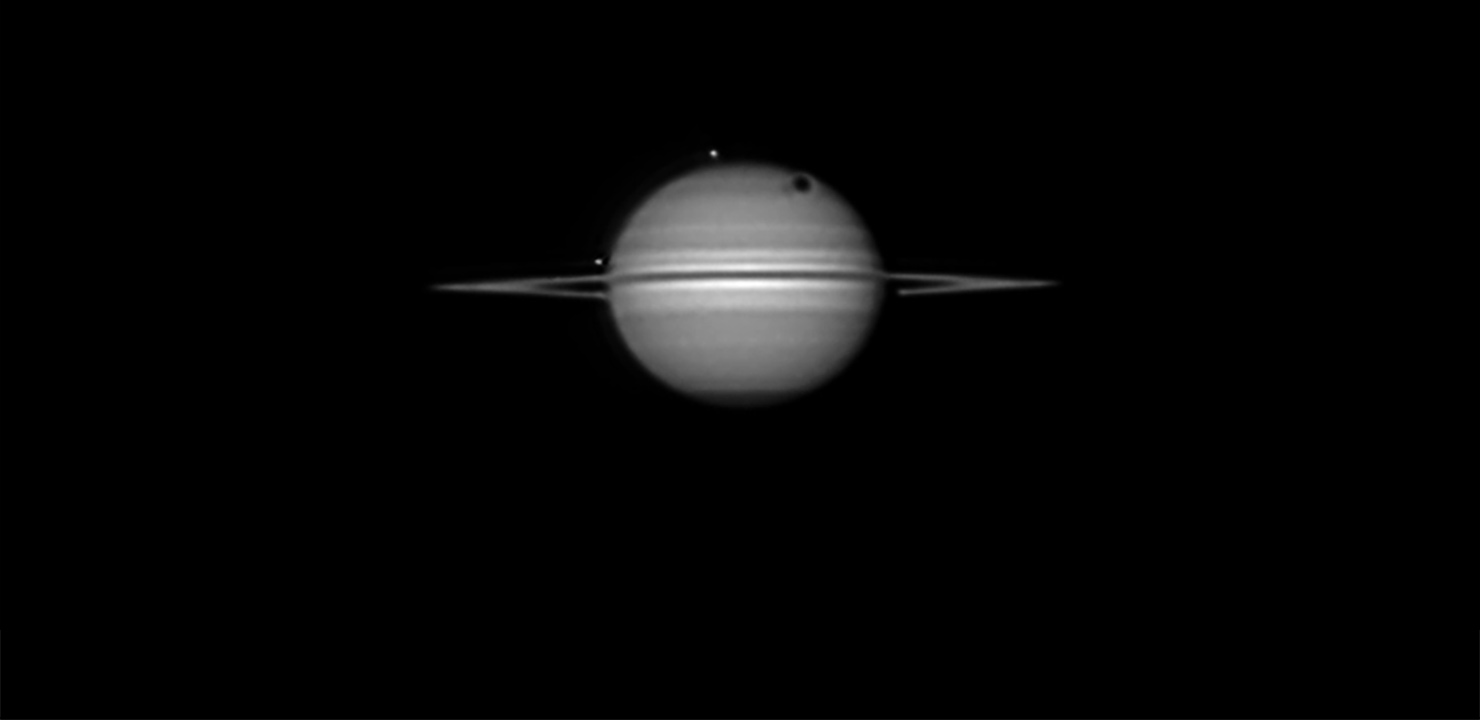
The second set of images are from August 19th through Oct 6, 2025. The September 4th event was quite memorable since it rained at 11:30pm local time on September 3rd. By 1:00am on Sept 4th, it was still completely overcast. Then by 1:30am local time the clouds began to clear, and I was able to align my Go To scope on Polaris and Fomalhaut. I started imaging Saturn at 1:52 am local time. The weather conditions kept improving throughout the night with clear, steady seeing with only a slight haze and humidity. Then at 4:07 am the weather took a turn for the worst with a few passing cloud banks. By 4:22 am it was completely overcast and remained that way through sunrise. I was able to image approximately 90% of the transit. I only lost 37 minutes from the beginning and 37 minutes from the end. The other moon that appears in the image is Tethys. If you look closely just above the rings, you can see a shadow transit of Tethys just about to start. Had it not clouded over, I would have continued imaging this transit once the shadow of Titan left the disk. Overall, a very successful imaging session. The months June 1st through November 30th are Hurricane season in Florida. In 2025 we were fortunate not to have had any tropical storms or hurricanes hit Florida.
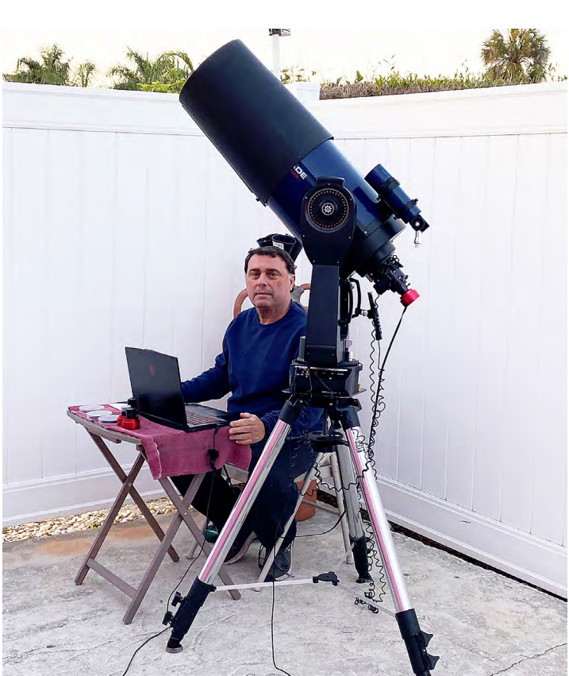
All the Saturn images were taken using a Vernonscope 1.25x Barlow and a ZWO ASI 462MM monochrome camera, therefore, the image scale remained constant. See figure 3 You can clearly see that the disk of Saturn is increasing in angular diameter and thus appears larger with each imaging run. The angular diameter of Saturn increased from 16.4” on May 15, 2025 to 19.4” on October 6, 2025. The September 20th transit occurred one day prior to Saturn’s opposition. Note how the shadow of Titan began just above the ring plane on May 15th and rose higher on the disk of Saturn with each passing transit. On Sept 20th, the moon Titan was just below its shadow which was impressive. The final shadow transit occurred on Oct 6th were the shadow “grazed” the disk of Saturn. The Shadow Transits from August 19th through Oct 6th were under clear skies and I was able to record each event from beginning to end. I therefore was able to make animations of these transits. All these images were taken after midnight and into the early morning hours prior to sunrise. I had to stay awake all night as to not miss these events. This sacrifice was well worth the loss of sleep.
In conclusion, the mission was complete. I was able to successfully image all ten remaining shadow transits of Titan and submitted my results to the Association of Lunar and Planetary Observers (ALPO) https://www.alpo-astronomy.org/ Planetary Virtual Observatory and Laboratory (PVOL) http://pvol2.ehu.eus/pvol2/images/by?uid=gshanos and to hstjupitergroups.io for archive and research. I await the next shadow transit of Titan in 2038.
Related Topics