

The Total Lunar Eclipse Experience
April 2026 :
A total lunar eclipse was visible throughout the United States during the early morning hours on Tuesday, March 3, 2026. Unfortunately, this was not a prime-time eclipse with the Moon entering the penumbra at 3:44am local time (8h 44m UT) from Sarasota, Florida. The west coast of the United States was favored since they could view the entire eclipse from beginning to end. On the East Coast, totality occurred at 6:04am local time (11h 04m UT) with the Moon being very low on the western horizon.
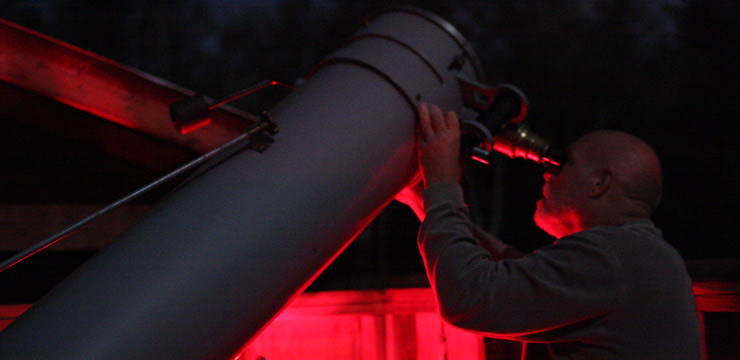
The weather was completely overcast the night before, fortunately the forecast called for clear skies after midnight on March 3rd. I was able to get two hours of sleep before awakening at 1:30am to see that the skies had completely cleared down to the horizon. The temperature was comfortable at 66°F with 87% humidity. I set up my equipment in a fenced area on the side of my house that had a view of the western horizon. My equipment included a Seestar S50 along with an Orion ED80T carbon fiber triplet apochromatic refractor on an Orion Sirius G mount. I took a snapshot of the Moon every 5 minutes with the Seestar and a 60 second video with the refractor every 15 minutes. Overall, the Seestar images were equivalent if not better than those taken with a more conventional refractor setup. (See figures 1, 1a, 2, 2a) Just prior to totality, I had to shut down the Seestar S50 and move it to my driveway in the front yard where I had a better view of the western horizon. I was not able to take any totality images with the refractor since the Moon was below the fence.
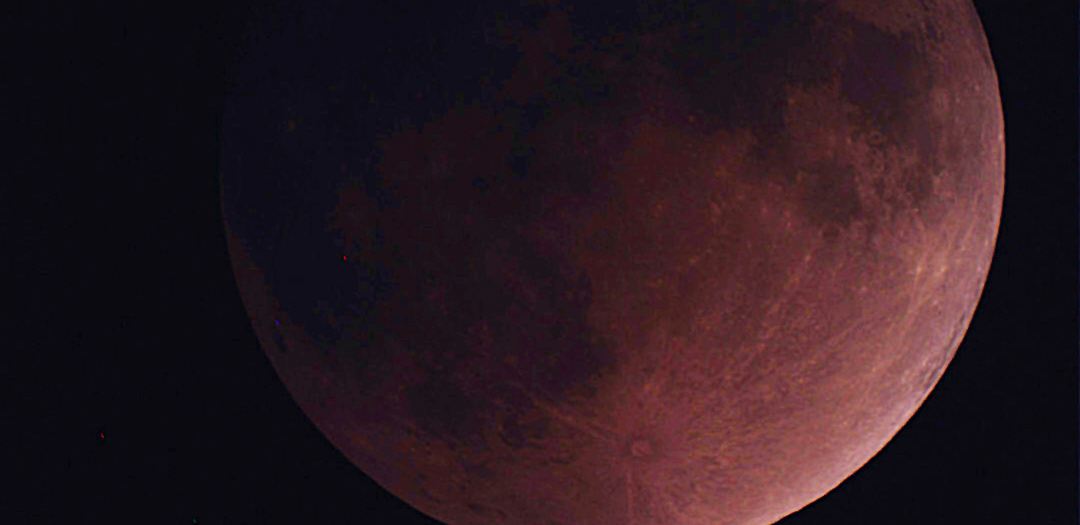
I reside on a barrier island in Sarasota, Florida called Longboat Key. One end of the island on the east faces Sarasota Bay while the other end facing west the Gulf of Mexico. This creates a laminar flow which stabilizes the atmosphere creating overall better seeing conditions than further inland. This is a definite advantage for planetary imaging since you are at high magnification. This laminar flow is also helpful for wide field astrophotography since fine detail on the surface of the Moon and deep sky images are also enhanced. The Moon was only 10 degrees above the western horizon when totality occurred from my location. The Moon set slowly behind the condominiums facing the beach on the Gulf of Mexico. By this time, the sky was blueish in deep twilight. I took a snapshot every minute until the Moon set behind the condominiums. The seeing was rather good considering the very low altitude. I only took one 60 second video which was aligned and stacked in the Seestar S50. (See figure 4) However, the individual snapshots appear closer to the naked eye/binocular view of the eclipse than the aligned and stacked video images. (See figure 3 & 4)
The naked eye and binocular views of totality were incredible! I would give this eclipse a Danjon number of 2. The Danjon scale is a five-point scale useful for measuring the appearance and luminosity of the Moon during a total lunar eclipse. It was proposed by Andre-Louis Danjon in 1921. The Danjon scale is usually performed naked eye at mid-totality and given the values L1 to L5. Since I could only witness the beginning of totality, I would give this eclipse a Danjon number of L2. An L2 eclipse is deep red or rust colored with a very dark central shadow, while the outer edge of the umbra is relatively bright. (See Figures 3 & 4)
After the eclipsed Moon was no longer visible, I dismantled my equipment and logged in to YouTube to watch live stream videos of totality already in progress. (See Figure 5) I watched live streams from the Griffith Observatory, Yucca Valley in California, Santa Fe, New Mexico, Waimea, Hawaii, Perth, Australia and Dunedin, New Zealand until the very end of the eclipse. I really wish I could have witnessed and imagined the entire event. I was only able to image the penumbral, partial and very beginning of totality. At least I was able to image 6 minutes of totality with the Seestar S50. I consider myself fortunate to have had clear skies down to the horizon as well as overall good seeing conditions from my location on the east coast.
My philosophy on total lunar and solar eclipses is that all phases of the eclipse are just as exciting as totality. I typically view and image the penumbra and partial phases as we approach totality then the partial and penumbral phases as we leave totality. I have been fortunate to witness several total solar eclipses and experience the excitement generated during the partial phases as we approach totality. It never ceases to amaze me that after totality most solar eclipse chasers lose interest! Everyone is celebrating totality and people are not looking at the sun while it is still 98% eclipsed! Not me, I am photographing the eclipse right up to fourth contact! The same is true for lunar eclipses, I begin once the Moon enters the Earth’s penumbra and end once the Moon leaves the penumbra.
Fortunately, there is another partial lunar eclipse that will occur in the United States on August 27-28, 2026. This eclipse is 96% partial- almost total but not quite. The earthshine should appear spectacular during maximum eclipse. This event is at a more “reasonable time” starting at 9:23pm on August 27, 2026, with maximum eclipse at 12:12am and ending at 3:01am on August 28, 2026 Eastern Time. The Universal Times are 1h 23m, 4h 12m and 7h 01m respectively on August 28, 2026. Something to look forward to this summer. Unfortunately, August is approaching peak hurricane season in Florida so let’s hope for clear skies.
Overall, the March 3rd, 2026, total lunar eclipse from my location was a complete success! I am grateful for the ideal weather, seeing and being able to witness totality naked eye and with binoculars. The advent of electronic assisted astronomy, especially the smart scope revolution, gave me a chance to take photographs and images that I can treasure for a lifetime as well as share with the world through the internet.

YouTube archive videos of the Eclipse:
- LIVE Total Lunar Eclipse (Blood Moon) March 3, 2026
- TOTAL LUNAR ECLIPSE | MARCH 3, 2026 | GRIFFITH OBSERVATORY
- LIVE: Total Lunar Eclipse (Blood Moon) - March 2–3, 2026
References:
- Time and Date. Com Total Lunar Eclipse on March 2–3, 2026 – Where and When to See
- Time and Date.com Partial Lunar Eclipse on August 27–28, 2026 – Where and When to See
- Danjon Scale: NASA - Danjon Scale of Lunar Eclipse Brightness
- Danjon Scale: Danjon scale - Wikipedia
Related Topics