


Welcome to the Artemis Generation
May 2026 :
Do you remember when humans flew to the Moon?
As a lifelong astronomy and space enthusiast in my early 50s, I didn’t remember, because it never happened during my time on Earth. My interest in science and space exploration was fueled early on by the Voyager missions to the outer planets, and watching some of the early launches of the Space Shuttle – back when historic space flights would interrupt regular television programming for all to see.
I distinctly remember one evening, I can’t remember exactly when, but I know it was sometime in the early 1980s: looking up at the crescent Moon during a family trip, my Dad told me that men had walked on the Moon. I was struck by this statement. Prior to this time, such a feat seemed extraordinarily unlikely to younger me, so I never even considered it a possibility. I was aware that the Moon was about a quarter the size of Earth, was about a quarter million miles from us, so far away that it took a whole month to make one trip around us. Men had walked on the Moon? How did they do it? Why aren’t they there now? Can (or will) they do it again? I had to know more. So in the years that followed, as I was simultaneously learning to explore the sky with my small telescope, I started to slowly gain this knowledge by, in the days before the internet, reading old books about the Moon at the library. There I learned all about Neil and Buzz, the lunar landers, the mighty Saturn V rocket… it all seemed so new and exciting.
I felt like I had gained a great deal of knowledge about the Moon, and the Apollo missions to explore it. I would later meet Captain Alan Bean, and was captivated by his stories about his journey to the Moon on Apollo 12, the second lunar landing mission. He even gave me an autographed print of his “Giant Leap” painting.
But, no one had been to the Moon in my lifetime. I never felt connected to human exploration of the Moon. It was all history, knowledge gained in old books from grade school days, and for decades, that seemed like it would never change.
This would change on April 1, 2026, when four astronauts: Commander Reid Wiseman, Pilot Victor Glover, Mission Specialists Christina Koch and Jeremy Hansen, climbed into their Orion capsule called Integrity, and lifted off from Launch Complex 39B at Florida’s Kennedy Space Center at 6:35pm EDT (22:35 UTC) on a journey unlike any previously embarked on.
Named for the sister of Apollo in ancient Greek mythology, the Artemis program is NASA’s 21st century ambition to establish sustained and permanent human presence on the Moon.
The first test flight, Artemis I, launched on November 16, 2022 and lasting 21 days, was the first launch of the full-stack Space Launch System (SLS) rocket and uncrewed Orion capsule to test the hardware, systems, and procedures for humanity’s next flight to the Moon.
Artemis II, still considered a test, was the first crewed flight of the Artemis program, and the first mission to send humans beyond low Earth orbit since Apollo 17 in late 1972. At long last, we were going back to the Moon.
Something that wasn’t available during Apollo, anyone with internet access could tune into the Artemis II mission at any time from pre-launch preparations to post-splashdown recovery via NASA’s streaming service or on YouTube. There were two dedicated channels running continuously: one for the official mission broadcast, consisting of video from onboard showing crew activities, communications with Mission Control, and interviews; the second channel was a continuous feed from the external cameras, which were modified GoPro action cameras mounted to the articulating solar wings on Orion’s service module. The official mission channel would play daily mission summary highlights every hour during crew rest periods, alternating with external spacecraft camera views.
Additionally, NASA would spin up dedicated video feeds for highlighted events, including launch and splashdown, proximity operations and of course, the lunar flyby. All of these videos remain readily available for viewing.
Having this continuous live coverage of the mission provided a presence that the Apollo generation did not have. It felt not that the astronauts were on some faraway adventure, so distant and removed from life here on Earth, but that we were there with them the whole time. How many of you had Artemis II streaming continuously 24 hours a day? Were you a part of this mission?
With a total of 32 cameras on board, including external and internal cameras, cameras in personal divides, and the cameras used for the lunar science portion of the mission (think astrophotography cameras and lenses), there was no shortage of incredible video and imagery to view. Images from still cameras were downlinked daily and placed on NASA sites, and through NASA Johnson Space Center’s Flickr photostream.
Flight Day 1
While much of the initial attention and excitement was still focused on the spectacular launch of Artemis II, the crew got to work right away. After conducting an apogee raise burn, Integrity separated from its Interim Cryogenic Propulsion Stage (ICPS), and we had a live cockpit view inside Integrity as Pilot Victor Glover took the controls to manually guide the capsule towards a pair of docking targets on the ICPS. While there were no docking adapters on ICPS, and the Artemis II Orion capsule was never intended to contact another spacecraft, this exercise, known as proximity operations, was meant to demonstrate the capabilities of the Orion capsule and its European Service Module, and the crew’s ability to maneuver it in space in preparation for future flights that will require docking with additional spacecraft.
Flight Day 2
One of the most critical phases of the mission occurred on flight day 2, when Artemis II Mission Management Team gave the “Go for TLI” call (TLI = trans-lunar injection). This is the maneuver that would boost Integrity and its crew out of Earth orbit, the first time such a flight profile had been conducted since Apollo 17 in 1972. Using Orion’s main engine, a slightly modified Space Shuttle Orbital Maneuvering System (OMS) hypergolic thruster, Artemis II was sent on its way to the Moon during a five minute and 50 second burn that started at 7:45pm EDT on April 2. It is notable that this was the last major maneuver required to complete the mission as planned.
As significant as the TLI maneuver was, spaceflight jargon, telemetry numbers, and lines projected on a map do little to engage public fascination, so the crew took advantage of their last night period before the lunar encounter to turn their cameras back towards Earth, and wow, what a sight that was!
Do you relish a nighttime landscape illuminated by nothing other than Moonlight? Have you ever observed the northern lights (aurora borealis)? How about the southern lights (aurora australis)? What about zodiacal light, sunlight scattered off interplanetary dust particles? How about seeing all of these things, all at once?
The first captivating image from Artemis II portraying all of the above, shows Earth bathed in Moonlight, auroral arcs hugging both north and south poles, as well as a tinge of sunset, suspended on a starry backdrop with the planet Venus.
The remainder of the day included astronauts outfitting the cabin for their upcoming science mission and additional tests.
Providing a striking demonstration of Kepler’s Second Law of Planetary Motion, Integrity reached the halfway point between Earth and the Moon just 26 hours after the TLI burn, and would continue to slow down, taking another three days to cover the remaining distance to the Moon.
Flight Day 3
Flight Day 3 continued with additional manual piloting demonstration, as Mission Specialist Christina Koch took the controls and executed a series of planned maneuvers in deep space.
Another mission highlight was when the astronauts began to see features on the lunar farside, including the gigantic Orientale basin. This was the first time humans had ever seen this lunar feature, as it was in shadow during all of the Apollo missions.
Flight Day 4
As Artemis II got closer to the Moon, and lunar observations started filling the crew’s time, conversations began to sound very familiar: dimming the cabin lights to avoid reflections and preserve dark adaptation, observing in low light, examining features on the lunar terminator, comparing albedo features at changing angles of incidence, the challenge of getting the best camera settings to capture features over a wide dynamic range… many of the same things we talk about on the observing field at our observatory events. The conversations beamed down live from Artemis II could have been Reid, Victor, Christina, and Jeremy looking through our telescopes, except what they described seeing was well beyond what our telescopes can show.
“...it is phenomenal, and the Moon we are looking at is not the Moon you see from Earth, whatsoever.”
Christina Koch
Flight Day 5
On the way to the Moon, Artemis II was scheduled to conduct three outbound trajectory correction burns, meant to fine-tune the placement of the spacecraft for both the lunar flyby and the return trip to Earth. However, the TLI maneuver was so accurate that only the last of the three planned maneuvers was needed.
Flight Day 5 concluded as Artemis II entered the lunar sphere of influence at 12:37 a.m. EDT on April 6, when the Moon’s gravity began to exert more force on the spacecraft than Earth’s gravity.
Reid has a few words to say as Artemis II approached the lunar flyby that would be a preview of things to come:
“I think one of the most interesting things right now is the four of us have looked at this Moon our entire lives, and the way we are responding to what we are seeing out the window is, it’s just like we’re a bunch of little kids up here, just, we cannot get enough of this. It’s amazing. Thank you for the privilege. ”
Flight Day 6
Flight Day 6 was the highlight of the mission: the lunar flyby. The day began with crew wake up and a personal greeting to Reid, Glover, Koch, and Hansen recorded by Apollo 8 astronaut Jim Lovell before his death last August.
“Hello, Artemis II! This is Apollo astronaut Jim Lovell. Welcome to my old neighborhood! When Frank Borman, Bill Anders, and I orbited the Moon on Apollo 8, we got humanity’s first up-close look at the Moon and got a view of the home planet that inspired and united people around the world. I’m proud to pass that torch on to you — as you swing around the Moon and lay the groundwork for missions to Mars … for the benefit of all. It’s a historic day, and I know how busy you’ll be. But don’t forget to enjoy the view. So, Reid, Victor, Christina, and Jeremy, and all the great teams supporting you – good luck and Godspeed from all of us here on the good Earth.”
To complete the bridge from Apollo 8 to Artemis II, the crew presented a flown Apollo 8 patch that was flown on that mission in December 1968.
Distance Record
At 1:56pm EDT, Mission Control informed the Artemis II crew that they had surpassed humanity’s greatest distance record of 248,655 miles set by Apollo 13 astronauts Jim Lovell, Jack Swigert, and Fred Haise on April 15, 1970. Integrity and her crew would ultimately reach a maximum distance of 252,756 miles.
In response, Jeremy Hansen replied:
“From the cabin of Integrity here, as we surpass the furthest distance humans have ever traveled from planet Earth, we do so in honoring the extraordinary efforts and feats of our predecessors in human space exploration. We will continue our journey even further into space before Mother Earth succeeds in pulling us back to everything that we hold dear. But we most importantly choose this moment to challenge this generation and the next to make sure this record is not long-lived.”
Dedication of Lunar Craters
Jeremy Hansen prepared an emotional presentation to suggest names for two unnamed lunar craters in honor of the Artemis II: Integrity, a 3.7-mile diameter crater located at 2.7°N, 104.9°W, was suggested in honor of the first spacecraft to take humans to observe the lunar farside. The second, Carroll, a 3.5-mile diameter crater located at 18.8°N 86.5°W, on the nearside/farside boundary just west of Oceanus Procellarum, and visible from Earth during favorable librations and described as “a bright spot on the Moon” by Hansen, is to be named Carroll for Commander Reid Wiseman’s late wife Carroll Wiseman, who died from cancer in 2020.
It was this moment that Reid said had the crew the most bonded, the pinnacle moment of the entire mission.
The Lunar Flyby
In another departure from Apollo, Artemis II had its own science team on the ground, including a dedicated console position at Mission Control Center in Houston. The lunar science team comprises experts in lunar geology, impact cratering, volcanism, polar science, imaging, and visualization that operated out of two special rooms integrated with the main Mission Control: the Science Evaluation Room (SER) provided science input during live operations, and the Science Mission Operations Room processes data, evaluates imagery, and supports rapid analysis.
There was a seven-hour window for lunar observations, when the astronauts alternated in pairs with time at the window and time as support. The astronauts in the windows recorded lunar observations using cameras, tablets, and audio recordings. The astronauts in the support positions would log activities and conduct situation reports, communicating with Mission Control on the progress of observations. The lunar observations were choreographed using the Lunar Targeting Package, a digital lunar atlas that helped the astronauts identify features on the Moon and plan their observations. NASA indicated in a later press conference that the Lunar Targeting Package would eventually be made public. This would certainly be a useful tool for our own lunar observation nights at Seagrave Observatory.
The crew of Artemis II witnessed Earthset and went into a 40-minute communications blackout as they went around the back of the Moon. Because Integrity was on a free-return trajectory around the Moon, there was no engine burn to enter lunar orbit like most of the Apollo missions did. Therefore, there were no tense moments in Mission Control waiting for the reacquisition of communications, and the astronauts were able to peacefully coast through the blackout period while continuing to conduct their lunar science observations.
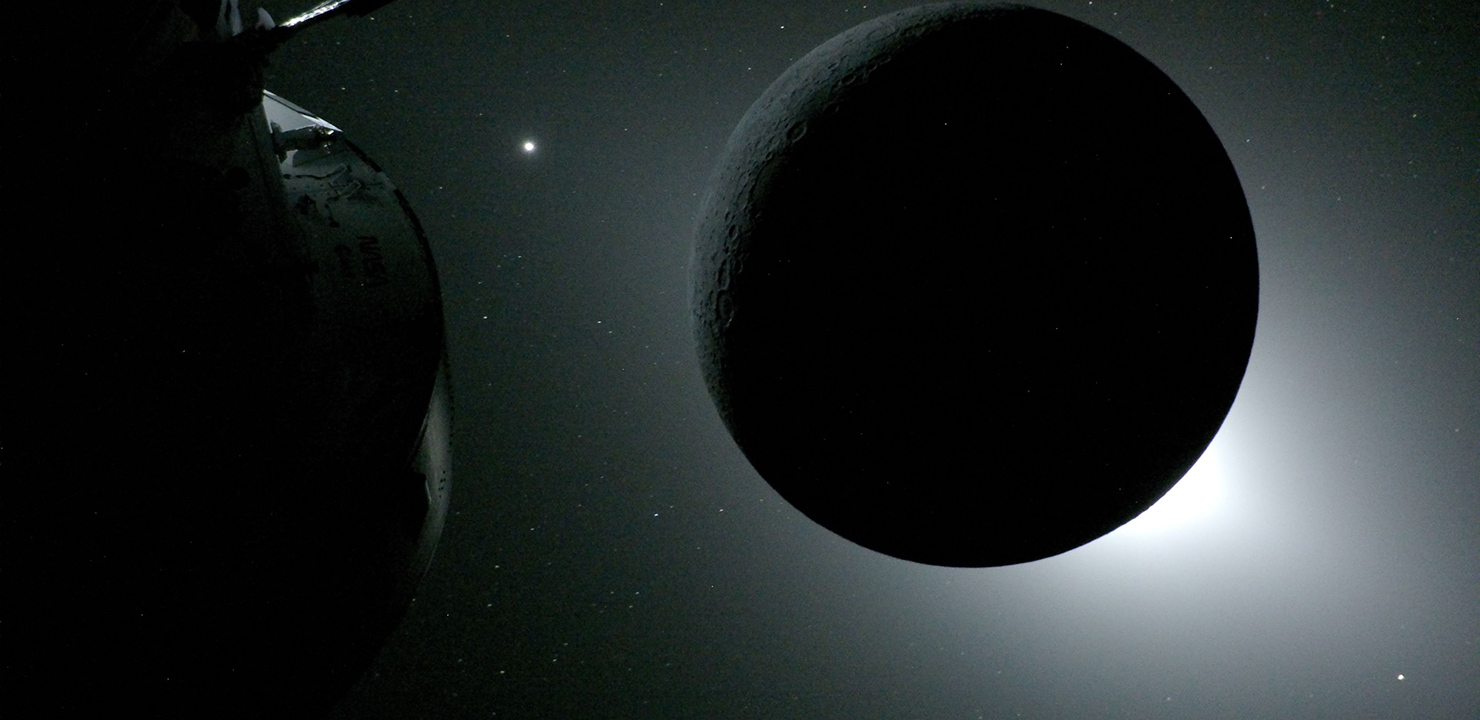
The highlight of the lunar flyby was undoubtedly the total solar eclipse. Many of us have experienced the excitement of traveling to a faraway destination to see a total solar eclipse: the lead-up and growing anticipation, making sure we see everything we set out to look for, making sure we got just the right shot, the real-time reactions and emotions to witnessing a spectacle that lasts mere minutes, and then, when it’s all over, trying to find the right words to describe what we just saw. The Artemis II crew took us along on their eclipse trip, and their memorable reactions to it were nothing short of inspiring.
The astronauts donned safe solar viewing “eclipse” glasses, the same ones we used for the recent North American total eclipses of 2017 and 2024, and the annular eclipse of 2023. The photo shows Victor Glover wearing a set of solar eclipse glasses from the October 2023 annular eclipse at Petroglyph National Monument, the same location from which a half-dozen Skyscrapers members observed that eclipse.
Being much closer to the Moon than us here on Earth, they got to enjoy 54 minutes of totality, during which they were tasked with looking for a whole set of phenomena, some like we usually do: the solar corona, Earthshine, stars and planets visible, and some, that are just not possible from any vantage point on Earth, such as lofted lunar dust and impact flashes.
Reid reported that he and Jeremy had seen five impact flashes near or south of the equator on the Earth-facing side of the Moon. In response, the science team members in the Science Evaluation Room were said to be literally jumping up and down.
They had also described seeing the topography around the entire limb of the Moon, being backlit by the gray of the solar corona, and the everpresent Earthshine, under which lunar features could clearly be observed.
An exchange between Victor and the science team described some of the planets he was observing during the eclipse, including one that appeared distinctly orange.
“Victor, we suspect what you are seeing is Saturn and Mars. That reddish object is likely Mars, good opportunity to look to the future of where we’re going.”
“Yeah, we can absolutely see the color of Mars. That’s awesome!”
These words from Artemis II Commander Reid Wiseman to the science team at Mission Control provide a compelling rationale for why we explore:
“No matter how long we look at this, our brains are not processing this image in front of us. It is absolutely spectacular, surreal. There’s—I know there’s no adjectives. I’m going to need to invent some new ones to describe what we are looking at out this window.”
I couldn’t help but to have “The Blue Danube” by Johann Strauss II playing in the background while Artemis II was coming out of eclipse, as this music has always instilled in me visions of taking a journey to the Moon, thanks to it being featured prominently during those scenes in 2001: A Space Odyssey.
When the eclipse pictures were downlinked a few hours later, they were nothing short of stunning.
Flight Day 7
Long-Distance Call
Flight day 7 featured the first ship-to-ship communications from a deep-space spacecraft with the crew of Artemis II calling down to Expedition 74 astronauts Chris Williams, Jack Hathaway, Jessica Meir, and ESA astronaut Sophie Adenot on board the International Space Station, a distance of over 230,000 miles.
“The thing that changed for me, looking back at Earth, was that I found myself noticing not only the beauty of the Earth, but how much blackness there was around it, and how it just made it even more special. It truly emphasized how alike we are, how the same thing keeps every single person on planet Earth alive. We evolved on the same planet, we have some shared things about how we love and live that are just universal, and the specialness and preciousness really is emphasized when you notice how much else there is around it.”
Christina Koch
to Jessica Meir, Expedition 74
Science Debrief
Flight Day 7 included a post lunar flyby conference where the crew was debriefed by the science team after initial analysis of date, images, and voice notes transmitted overnight, and while the astronauts' memories of their observations were still fresh. We heard even more discussions about how the astronauts observed features on the Moon with and without the bright Earth in view,
Go for Deep Sky Imaging
In a surprising request for a NASA mission, but a familiar one to us as amateur astronomers, at the end of Flight Day 7, Reid sent a request to mission control to turn off the lights on the external cameras so that the crew could conduct some deep-sky photography out the window of Integrity.
Flight Day 8
With the science segment of the mission largely over, Flight Day 8 focused on some housekeeping tasks, such as repressurizing the cabin from 10.2 psi to 14.7 psi (concluding a test initiated on Flight Day 5), stowing the exercise equipment, and conducting some space-to-ground calls, including a live press conference.
In keeping with the continuity of the Apollo program, the Artemis II astronauts presented the American flag that was destined to be planted on the surface of the Moon by the Apollo 18 mission, which was cancelled in 1970 and never flown.
Additionally, Artemis II carried on board the flag that was flown on STS-1 Columbia, the first Space Shuttle mission, STS-135 Atlantis, the final Space Shuttle mission, and DM-1, the first crewed flight of SpaceX’s Dragon capsule to the International Space Station.
Flight Day 9
Flight Day 9 was packing day, as we can all relate on the day before a return from a long trip away. Stowing equipment, reconfiguring the cabin, and reviewing the reentry procedures occupied a large portion of Flight Day 9. Artemis II also conducted one final return trajectory correction burn to put it on its precise path home.
Also, as a reminder of Keplerian motion, Artemis II crossed inside the halfway point from the Moon back to Earth just over a day before reentry.
Flight Day 10
Flight Day 10 was the grand homecoming. As Integrity rapidly approached Earth, the crew had the chance to get some final views of the Blue Marble as they rapidly approached our home planet.
There had been some trepidation about the performance of Orion’s heat shield when the capsule slams into the atmosphere going at a near-record 24,661.21 mph (mach 33), especially after seeing how the heat shield of Artemis I’s Orion capsule incurred some damage during its reentry. Mission planners had modified the approach to a more lofted entry, which put less stress on the parts of the heat shield that incurred damage on Artemis I. This had engineers, mission planners, and the crew confident that Integrity and her crew would return without cause for concern.
One last maneuver placed Integrity on its final entry corridor, and the ship moved to an attitude to jettison its service module, which performed extremely well during the entire flight. We had incredible views of the separation, and the spacecraft maneuvered into an attitude to prepare for entry interface, after which an expected six-minute period of radio blackout was encountered.
Integrity splashed down at 8:07pm EDT, at a mission elapsed time of 9 days, 1 hour, 32 minutes and 15 seconds, with a total distance traveled of 694,481 miles. After an entry corridor range of 1,957 miles, Integrity splashed down within one mile of its targeted coordinates.
Recovery and crew extraction took approximately 90 minutes, and when the hatch first opened, all I could think of was how wonderful it must have been to smell the ocean for the first time after being so far away for ten days.
It was only after Reid, Victor, Christina, and Jeremy were back on Earth that the significance of it all began to settle in. Do I remember when humans flew to the Moon? My lifelong answer of “no one has been to the Moon in my lifetime” was no longer true.
The following day, the Artemis II crew was back in Houston for their post-landing press conference, and they had some inspiring words to say.
“I have absolutely no idea what to say. Twenty-four hours ago Earth was that big out the window and we were doing Mach 39 and here we are back at Ellington back at home.”
“It’s a special thing to be a human, and it’s a special thing to be on planet Earth.”
Reid Wiseman
“I have not processed what we just did, and I’m afraid to even start trying.”
Victor Glover
“A crew is inescapably, beautifully, dutifully linked. So, when we saw tiny Earth, people asked our crew, what impressions we had. And honestly, what struck me, wasn’t necessarily just Earth, it was all the blackness around it. Earth was just this lifeboat hanging undisturbingly in the universe. I know I haven’t learned everything that this journey has yet to teach me, but there’s one new thing I know, and that is, planet Earth, you are a crew.”
Christina Koch
“You haven’t heard us talk a lot about the science, the things we learned, and that’s because, they’re there, and they’re incredible. But, it’s the human experience that is extraordinary for us. And it sounds like … for you, too.”
“I would suggest to you that, when you look up here, you’re not looking at us. We are a mirror reflecting you. And if you like what you see, then just look a little deeper. This is you.”
Jeremy Hansen
So where do we go from here? Never stop exploring. We have a whole universe to explore, and, as we can look to the Moon as inspiration, there is always something fascinating to discover, even in our own backyards, parks, and wild spaces.
As for the Artemis program, the journey continues, and for now, progress is being made. At the end of April 2026, the core stage for the next Artemis flight, Artemis III, arrived at the Kennedy Space Center in Florida to begin assembly and stacking. Originally, the next flight was intended to be the first lunar landing mission of the Artemis program, but the schedule has been revised in order to reduce the interval between flights, as well as to test and prepare for crew operations with lunar hardware. The mission will remain in Earth orbit, with the crew conducting rendezvous and docking procedures with lunar landing hardware provided by one or both of NASA’s commercial partners SpaceX and Blue Origin. The mission, which will somewhat resemble the profile of Apollo 9, is scheduled to launch no earlier than late 2027.
We look forward to meeting our next crew of lunar explorers, as well as having many more inspiring conversations with the Integrity’s first crew. Oh, and there’s a whole lot more science, and about 7,000 photos of the Moon that we’ll be seeing more of very soon.
Welcome to the Artemis Generation.

References & Additional Information
- Artemis II Mission Milestones: An Image and Video Recap
- Artemis II Mission Coverage
- Artemis II Flight Day Highlights
- NASA’s Artemis II Crew Flies Around the Moon (Official Broadcast)
- Artemis II Flight Day 6: Crew Ready for Lunar Flyby
- Artemis II Flight Day 6: Lunar Flyby Updates
- Artemis II Multimedia
- NASA Answers Your Most Pressing Artemis II Questions
- Meet NASA’s New Artemis II Science Officers
- Artemis II: Observe the Moon Like an Astronaut
- Impact Flash! Citizen Science Project
- Artemis II Crew Flies Around the Moon
- NASA’s Artemis II Crew Eclipses Record for Farthest Human Spaceflight
- Space-to-Space Call: NASA's Artemis II Astronauts and the International Space Station
- NASA’s Artemis II Mission to Fly Legacy Keepsakes with Astronaut Crew
- NASA’s Orion Artemis II Optical Communications System (O2O)
- ANU provides laser communications support for NASA’s Artemis II crewed moon mission
- GoPro Cameras are Flying Aboard NASA’s Historic Artemis II Mission Around the Moon


